
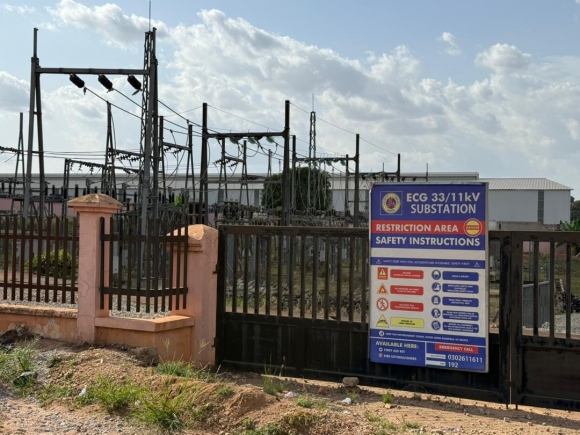
The government of Ghana and the International Monetary Fund (IMF) are pushing to fast-track private sector participation in the Electricity Company of Ghana (ECG) to help curb high commercial and technical losses. However, the government has ruled out an outright sale or full privatisation, opting instead for public-private partnerships (PPAs) and concession models
For Dr Theo Acheampong, who is a senior adviser at the Ministry of Finance, the private sector participation in ECG will begin by early 2027 despite the opposition from organised labour.
Speaking as part of a panel discussion on Joy FM’s News File programme on Saturday, May 16, 2026, the Technical Adviser at the Ministry of Finance said the government was preparing to move ahead with ECG’s restructuring before the end of this year.
“The private sector participation under ECG will happen,” Dr Acheampong said. “End of year going into early next year.”
Responding to the comment by Dr Acheampong, Dr Kwabena Nyarko Otoo, a Deputy Secretary-General of the Trades Union Congress (TUC), who joined the discussion via telephone said: “the unions are fully prepared and will do everything to ensure that we do not privatise ECG.”
He added that the TUC and its affiliates were “ready to use every legitimate means” to stop the move.
The government has maintained that the process does not amount to privatisation. In a statement issued on December 30, 2025, the Ministry of Energy and Green Transition said the state would not sell ECG.
“The approved Private Sector Participation framework is not a sale or divestiture. Rather, it involves the strategic deployment of private sector expertise through multiple concession arrangements to support and improve specific operational areas of ECG.”
In a statement dated May 15, 2026, talking about transition when the IMF announced that Ghana had concluded its Extended Credit Facility arrangement and agreed to a new 36-month Policy Coordination Instrument (PCI), the IMF said accelerating private sector participation in ECG’s distribution operations remained necessary for Ghana’s economic recovery. The Fund also warned about fiscal risks linked to state-owned enterprises and called for reforms in the power distribution sector.
Godfred Bokpin, a Professor of Finance at the University of Ghana, contribution to the Joy FM Newsfile discussion said state-owned enterprises, especially ECG, continued to place pressure on the national economy.
According to him, the combined burden of state enterprises amounts to about 2.5 per cent of Ghana’s Gross Domestic Product annually, equivalent to more than US$2 billion at current exchange rates.
“Whilst the accounting methodology would essentially take care of government central debt in its calculation, we were actually accumulating debt through these state-owned enterprises which eventually will come to the table of the Finance Minister to settle,” Prof Bokpin said.
Former ECG Managing Director Samuel Dubik Mahama also spoke about operational difficulties within the company.
He explained that under the cash waterfall system used in the energy sector, ECG receives only part of the money it collects from consumers.
“When you give ECG 300 million for a monthly operation, salary will take 110 away,” Mr Mahama said.
He said after salaries, hospital bills, fuel and operational costs are deducted, little money remains for maintenance and infrastructure investment.
Mr Mahama also questioned why ECG carries financial obligations for all Independent Power Producers even though the company distributes electricity mainly in the southern and middle parts of the country, while the Northern Electricity Distribution Company serves the northern sector.
With Ghana’s installed electricity generation capacity estimated at 5,641 megawatts in 2024 and ECG’s peak demand standing at about 2,700 megawatts, he argued that ECG was being made to shoulder costs beyond its revenue capacity.
“You are asking a company that is consuming 2,700 to pay a bill of 4,000-plus,” he said.
Dr Otoo rejected suggestions that ECG’s current performance justified private sector participation.
He said the company had improved its monthly revenue collections from about GH¢900 million to GH¢2.1 billion against a revenue requirement of around GH¢2.5 billion.
“There is nothing wrong with ECG continuing what they are doing, the progress they are making thus far,” he said.
Dr Otoo also referred to Uganda’s electricity distribution concession with Umeme Limited, which operated the system from 2005 to March 2025.
He argued that electricity tariffs became too expensive for many citizens during the concession period.
