
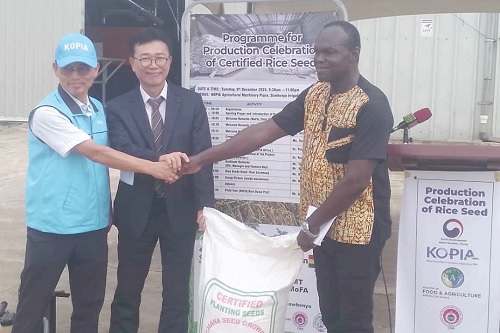
Ghana receives 370 tonnes certified rice seeds under K-RiceBelt project
Ghana has received 370 tonnes of certified rice seed as part of ongoing efforts to boost domestic rice production and reduce dependence on imports.
Provided under the Korea Partnership for Innovation of Agriculture (KOPIA), K-RiceBelt Project, the seeds were presented at a ceremony last Tuesday, at the Dawhenya Irrigation Scheme in the Ningo-Prampram Municipality in the Greater Accra Region.
The event, which brought together stakeholders from Ghana and the Republic of Korea’s agricultural sectors, marked the successful production of certified rice seed varieties developed by the Crops Research Institute of the Council for Scientific and Industrial Research (CSIR-CRI) with technical support from Korea’s Rural Development Administration (RDA) through the KOPIA Ghana Centre.
The varieties – AGRA Rice, Legon Rice 1, KoreaMo and Agyapa – were bred to offer higher yields, improve resilience and better grain quality.
The seed delivery forms part of the broader K-RiceBelt Project, a five-year initiative that began in September 2023 and will run until 2027.
The project is aimed at strengthening Ghana’s rice value chain by ensuring farmers have access to high-quality certified seed at no cost, ultimately reducing the country’s reliance on imported rice.
Project
So far, the K-RiceBelt Project has distributed 850 tonnes of certified rice seed nationwide.
By the end of the project, 5,000 metric tonnes are expected to be supplied, enough to cultivate about 100,000 hectares of land, nearly one-third of Ghana’s total rice-growing area.
Speaking at the ceremony, the Director of the KOPIA Ghana Centre, Dr Young Jin Kim, described the Dawhenya milestone as a turning point in Ghana’s drive for rice self-sufficiency.
“The production of certified seed goes beyond a technical achievement. It ensures quality, consistency and reliability, while improving the incomes and livelihoods of rice farmers across the country,” he said.
Dr Kim added that as rice consumption continues to grow, the project would significantly enhance Ghana’s capacity to reduce imports and build a sustainable domestic rice industry.
He also stressed that the achievement reflected the strength of collaboration between Ghana and Korea, adding that meaningful partnerships and local innovation were essential for improving food security.
Appreciation
The Director of Crop Services at the Ministry of Food and Agriculture, Solomon Ansah, on behalf of the minister, expressed appreciation to KOPIA and the government of South Korea for selecting Ghana as one of the seven West African countries to benefit from the K-RiceBelt Project.
He said with strong support from Dawhenya rice farmers and KOPIA’s technical expertise, CSIR scientists were able to develop improved seed varieties that would be distributed freely to farmers across the country.
Mr Ansah noted that Ghana is currently about 51 per cent self-sufficient in rice production, making improved seed varieties crucial to efforts to significantly reduce the rice import bill.
He expressed optimism that the new certified varieties would provide a strong foundation for achieving rice self-sufficiency and assured farmers that additional high-yielding varieties would be made available in the coming years.
Writer's email:
