
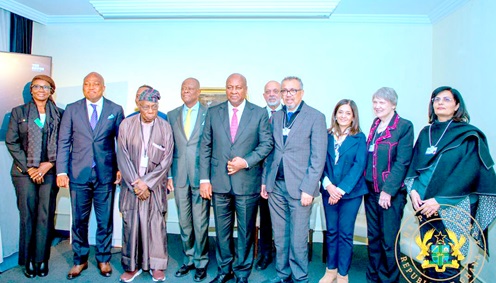
Ghana’s Reset blueprint must spread across Africa: President advocates at Davos - Calls for end to ‘triple dependency’
President John Dramani Mahama has declared that Africa must “pull itself up by its own bootstraps” and shape the emerging global order rather than remain trapped in what he termed “triple dependency” on foreign security, donor aid and raw material exports.
In an address at the World Economic Forum yesterday, the President said Ghana’s ongoing economic and governance turnaround is proof that execution beats excuses, but insisted that “we cannot be a jewel in the dirt”.
Launching the Davos Convening of the Accra Reset Initiative, President Mahama outlined a five-point action plan aimed at building genuine sovereignty across Africa and the Global South.
The plan focuses on investing in relevant skills, deepening regional integration, pursuing united negotiation, strengthening domestic production, and promoting accountable governance.
“Our world is at an inflexion point,” he told an audience of global leaders, including former Nigerian President Olusegun Obasanjo, who chairs the Guardians’ Circle of the Accra Reset.
“The multilateral system is breaking down. Africa intends to be at the table in determining what the new global order will look like,” he said.
From recovery to regional reset
President Mahama pointed to Ghana’s own recovery, single-digit inflation, a strengthened currency, reduced government size, and debt restructuring as evidence that change was possible.
He, however, warned that “Ghana’s success alone is not enough”.
“We must knit together the patchwork of success stories across Africa,” he said, adding that “We face a different pandemic: the pandemic of unfulfilled potential.”
The President identified the “triple dependency” trapping many African nations as dependence on others for security choices; on donors for health and education systems; and on exporting raw critical minerals without capturing value.
“This isn’t sovereignty. It is a trap,” he stated.
A practical blueprint
The Accra Reset, first announced at the UN General Assembly in September 2025, is framed as a “practical blueprint” for cooperation among willing nations.
It aims to move from resetting individual countries to resetting the entire development model.
President Mahama proposed concrete actions such as pooling negotiating power on critical minerals, creating regional manufacturing hubs, producing vaccines and technology locally, and building “prosperity spheres” across regional platforms.
“If we could mobilise the world to fight a disease, why can’t we mobilise to fight poverty, to fight dependency?” he asked, recalling the creation of the Global Fund two decades ago.
On the first pillar—investing in skills—President Mahama emphasised the need to move beyond general education and focus on competencies aligned with real jobs in the modern economy.
He called for targeted development in digital literacy, green energy technologies and advanced manufacturing to nurture a generation of young Africans capable of building and innovating, rather than merely consuming.
On the second pillar, which focuses on building together, he stressed that no single African country can industrialise in isolation.
The vision is to create integrated regional prosperity platforms, including cross-border manufacturing zones, interconnected energy grids, and shared digital infrastructure.
This collaborative approach would give African businesses the scale to compete and provide vast opportunities for workers across the continent.
On the third pillar—negotiating as one—President Mahama argued that fragmentation has weakened Africa’s bargaining power on the global stage.
He asserted that by forming united fronts on critical issues such as mineral beneficiation, trade agreements, and climate finance, the continent could become a formidable partner, turning unity from a slogan into a concrete strategic advantage.
On the fourth pillar—domestic production—President Mahama made a strong case for a strategic industrial policy to drive local manufacturing, create jobs, and reduce reliance on imports.
He stressed that dependence would continue if Africa did not manufacture essential goods from vaccines and medicines to semiconductors and solar panels within its own borders.
Revitalising industrial policy, he concluded, was not outdated but essential for survival and true economic sovereignty.
On accountability, the fifth and final pillar, the President linked good governance to sustainable development.
He insisted that Africa could not demand global investment while tolerating systemic corruption, waste, and inefficiency.
The “Reset”, he clarified, must be underpinned by genuine reform and measurable results that directly improve the lives of citizens.
Partnership, not pity
In a direct appeal, President Mahama said the Accra Reset was “not seeking permission” but building momentum.
He invited global partners to join a “coalition of the willing” based on shared vision and mutual respect.
“We didn’t come here to ask for charity,” he said.
“We want to leave a continent where young people don’t risk their lives crossing the Mediterranean because they have opportunity at home.”
The initiative will advance through upcoming engagements, including the African Union Summit in Addis Ababa next month and the Oslo Dialogues.
“The question is not whether the world needs this,” President Mahama concluded.
“The question is whether we dare to build it.”
About the Accra Reset
The Accra Reset Initiative is a Ghana-led, Global South-focused platform for practical cooperation to build sovereign capabilities, regional resilience and equitable growth.
Strategic partners include the African Development Bank, Global Fund, AfroChampions, Georgetown University and the Rockefeller Foundation.
