Invest to protect vulnerable communities from climate impacts — IWMI
A six-year European Union-funded project aimed at building climate resilience in the northern part of the country has ended with a call on policymakers to invest in long-term inclusive solutions that protect vulnerable communities from worsening climate impacts.
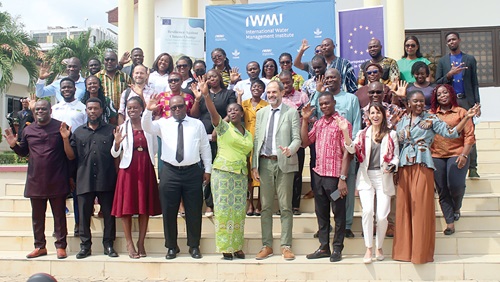
At a meeting to review the project in Accra yesterday, the Resilience Against Climate Change – Social Transformation Research and Policy Advocacy (REACH-STR) revealed that while many districts in the Upper West Region and Savannah Region remain highly exposed to climate and gender-related risks, others showed signs of resilience.
The project, which ran from 2019 to 2025 under the broader EU-Ghana Agriculture Programme (EUGAP), was implemented by the International Water Management Institute (IWMI).
Transformation
It focused on generating concrete research, building local capacity, and developing decision-support tools to improve how communities and policymakers responded to climate-related challenges.
In an interview, the Project Lead and Deputy Country Representative of IWMI and REACH-STR, Dr Charity Osei-Amponsah, said one of the biggest revelations was that society in rural areas was transforming technologically, socially and structurally.
“Farmers are adopting modern tools, infrastructure is improving, and exclusionary social norms are shifting. For instance, women are becoming more involved in decision-making at both the household and community levels,” she said.
Dr Osei-Amponsah also noted that certain districts remained resilient to climate shocks while neighbouring areas were identified as highly vulnerable.
“It is crucial that we conduct ground-truthing to understand why these areas are thriving. What makes them more resilient? These lessons can help guide future interventions,” she added.
Background
Beyond research, the (REACH-STR) project influenced national policies. It collaborated with over 15 ministries, departments, and agencies to co-develop tools, including the vulnerability map, ensuring ownership and uptake by the government.
The findings were repackaged into briefs and flyers to enhance accessibility for decision-makers.
Other partners included the Centre for Migration Studies of the University of Ghana (UG-CMS), Simon Diedong Dombo University of Business and Integrated Development Studies (SDD-UBIDS), and the Council for Scientific and Industrial Research – Science and Technology Policy Research Institute (CSIR-STEPRI).
Commitment
The Head of Co-operation of the EU Delegation to Ghana, Massimo Mina, reaffirmed the commitment of the EU to climate resilience and agricultural transformation.
“This project shows that when research, local knowledge, and policy come together, we can build stronger and more climate-resilient communities,” he said.
Mr Mina said the investment by the EU reflected a broader strategy to promote climate-smart inclusive food systems, particularly in the northern sector of the country.