
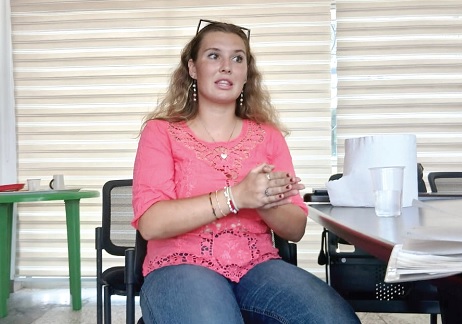
Peace Corps volunteer mobilises funds to build maternity ward for community
With about 200 pregnant women attended to each month in only one delivery room, Gbrumani Community-based Health Planning and Services (CHPS) compound in the Tolon District of the Northern Region struggles to meet demand for delivery services.
It is common for the facility to face competing demands at the same time, where, during emergency deliveries, other pregnant women in labour are compelled to await their turns or be transferred to ill-equipped traditional birth attendants for delivery services.
Others who are unable to wait give birth in the recovery rooms.
Touched by the fate of pregnant women contending with inadequate delivery rooms at the facility, an American Peace Corps Volunteer, Rian Silcox, is mobilising funds to build a six-room maternity ward at the facility to ease the strain.
Ms Silcox is a health volunteer posted to the Gbrumani CHPS compound, which also caters for four other smaller neighbouring communities. She is with the maternal and child welfare clinic at the facility, where she attends to pregnant women who go there for antenatal clinic and immunisation of babies.
Ms Silcox, who has already served one year of her two-year volunteer programme, was speaking to the Daily Graphic about her experiences as a Peace Corps Volunteer in Ghana.
This year marks 65 years of the United States (US) Peace Corps Volunteer programme in Ghana, and the US Embassy in Ghana commemorated it last Thursday, March 26, with the swearing-in of its largest cohort of 30 new Peace Corps Volunteers.
Pregnancies
She said because the facility catered for the health needs of four other smaller communities that did not have clinics, they attended to a huge number of patients, including about 50 pregnant women, a week and unfortunately, with only one delivery room.
She said initially, she was extremely open-minded about the problem because she thought that was how the health system in Ghana worked, but then, when her head in charge of nursing told her she needed more delivery rooms and that was not how she wanted to run the clinic, she felt the need to assist.
Currently, Ms Silcox said she had submitted the grants for the project, and she remained hopeful that within a month, the funds would be raised for her to start the project immediately.
“Right now, I am working with the contractor on how to start the work.
The longest the funding would take would be maybe a month,” she said.
She clarified that the Peace Corps was not paying for the project, adding that the Peace Corps did not provide money for any project; rather, they partnered the beneficiaries.
Aside from the building project, Ms Silcox said she had started a school health education programme, which, among others, educated students about their reproductive health issues.
Experience
On her experience working in a health facility in Ghana, she said, unlike Ghana, the US did not have a local health facility in the form of the CHPS compound, where there could be a direct local contact with the community and the facility.
She said here, because of that direct personal relationship the CHPS compound had with patients, they sometimes even did home visits as nurses to follow up on the patients, which was something one would not find in the US.
