
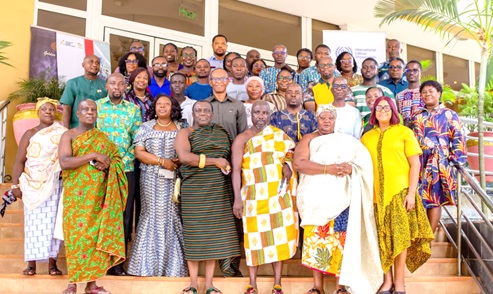
Policy dialogue on local procurement of apparel, textiles held in Kumasi
A national policy dialogue on local procurement of apparel, garments and textiles has been held in Kumasi in the Ashanti Region.
It was organised by the Association of Ghana Apparel Manufacturers (AGAM), with support from the International Labour Organisation (ILO).
It brought together key stakeholders, who discussed existing policies, identified gaps, explored opportunities and proposed recommendations to strengthen local procurement of textiles.
The country currently spends over $200 million annually on imported garments, while local factories operate below 40 per cent capacity.
Support
The Feyiasehene, Nana Addae Gyamera, who read a speech on behalf of the Asantehene, Otumfuo Osei Tutu II, said the apparel, garment and textile sector, when provided with the needed support, could contribute significantly to the country’s industrial renaissance.
“If we choose internationally and we lose our local focus, it will kill the textile sector locally. Let us use intentionality on our local products and do local production over excessive production,” he said.
“Let us be committed to a Ghana where creativity becomes prosperity and heritage becomes economic strength,” he said.
The Asantehene said the textile industry was not only about fabric, but represented identity, heritage, philosophy and status.
“The time has come for the nation to move decisively beyond rhetoric and embrace a deliberate national procurement culture that places Ghanaian industries at the centre of national development,” he added.
Export
The National Coordinator of the African Growth and Opportunity Act and the African Market Access Programme, Nana Poquah A. Adiamah, said the programme had, over the past two years, facilitated the export of locally produced apparel worth $45 million to the United States.
She said the local apparel industry had the capacity, and would continue to improve to meet global standards, adding “We are producing below 40 per cent”.
The coordinator proposed the passage of a law that would ensure 100 per cent local procurement of apparel and textiles.
She further appealed for support for suppliers, noting that the sector was highly capital-intensive, particularly when operated on a commercial scale.
National devt
The National Project Officer, Enterprise Development Productivity Ecosystems for Decent Work Project, International Labour Organisation (ILO), Onoma Asiedu, also said the textile sector was crucial to the development of the economy.
He said the sector had one of the biggest potentials for job creation and had contributed immensely to foreign exchange earnings, and added that prioritising investment in the sector would benefit the nation.
“Directing just a percentage of procurement to local industries will be a game-changer for actors and the national economy,” Mr Asiedu added.
Writer’s email;
