
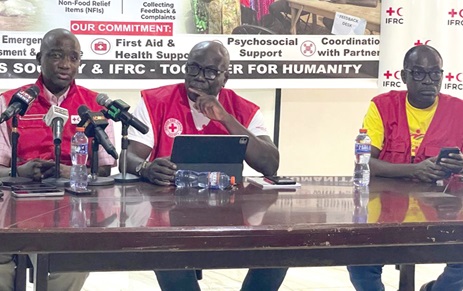
The Ghana Red Cross Society, in collaboration with the International Federation of Red Cross and Red Crescent Societies (IFRC), has launched a GH¢8.3 million emergency response operation to support 30,000 people affected by the floods that hit parts of the country in late June and early July 2026.
The six-month operation will focus on four severely affected regions, which are the Greater Accra, Central, Volta and Western-North, with interventions covering emergency shelter, water, sanitation and hygiene (WASH), health and well-being, relief and multipurpose cash assistance.
The IFRC Country Coordinator, Noor Pwani, said the floods had affected about 89,000 people, resulting in 34 deaths and leaving seven people missing.
He said the flooding occurred across seven regions, but the Red Cross had prioritised four regions for the emergency operation based on the severity of the impact and identified gaps in assistance.
Assistance
The Secretary-General of the Ghana Red Cross Society, Eric Gregory Kwatia, said 1,050 of the most vulnerable households would receive GH¢1,200 each through mobile money platforms.
He said the multipurpose cash assistance was intended to enable affected families to determine their most urgent needs, including food, health care, shelter repairs and other essential expenses.
Mr Kwatia said the operation would also provide 150 shelter kits, 2,000 blankets and 2,000 kitchen sets to vulnerable households whose homes had been destroyed or severely affected.
Under the health and well-being component, the Red Cross will distribute 2,000 insecticide-treated nets, train and deploy 200 volunteers in community health promotion, psychosocial support, first aid and disease surveillance.
The organisation will also distribute 7,000 health communication materials to promote disease prevention and other health messages in affected communities.
Mr Kwatia said 1,700 hygiene and dignity kits would be distributed to 850 households, while 20,000 AquaTabs would be provided to 2,000 households to support access to safe drinking water.
The Red Cross will also install 50 handwashing stations at public places, including health centres, schools and markets, and train 200 volunteers in hygiene promotion, infection prevention and control and community-led clean-up campaigns.
Another 500 sets of personal protective equipment will be provided for staff and volunteers involved in the operation.
The Ghana Red Cross Society said it was working with the government through NADMO and participating in national and district-level emergency coordination structures.
Mr Kwatia said the collaboration was intended to ensure that the Red Cross response complemented government-led interventions and avoided duplication.
He said the operation would also integrate protection, gender and inclusion measures, with priority given to female-headed households, children, older persons and persons with disabilities.
