
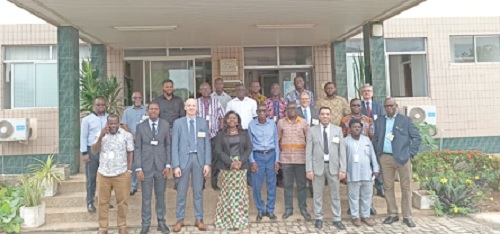
Review of GAEC research reactor utilisation underway
A team of experts from the International Atomic Energy Agency (IAEA) has started assessing the utilisation capabilities of the Research Reactor-1 (GHARR-1) of the Ghana Atomic Energy Commission (GAEC) at Kwabenya in Accra.
The review is to recommend ways to improve efficiency and long-term sustainability of the nuclear reactor for research purposes.
GAEC’s research reactor is a national tool that helps the country to check what is in the air, water, soil, food, and everyday materials, contributing enormously to safeguard public health, supporting industry and improving the quality of life for citizens.
For instance, it is used to detect pollution, study climate change, and support safe waste management.
The reactor also helps to ensure food and medicine safety, assists the police in analysing evidence during investigations, and supports mining companies by identifying minerals in rock formations and the soil.
The manufacturing sector also relies on it to test the quality of metals and other materials.
The team, led by the Head of the Physics Section at the Department of Nuclear Sciences and Applications of the IAEA, Dr Danas Ridikas, also includes four other experts.
They are Dr Lubomir Sklenka from the Czech Republic, Dr Bilal Bakkari from Morocco, Dr Sunday Jonah from Nigeria, and Dr Nuno Pessoa Barradas from Portugal.
They will be in the country from December 8, to 12, 2025.
Review mission
The review mission, known as the Integrated Research Reactor Utilisation Review (IRRUR), is an IAEA peer-evaluation service being conducted at the request of GAEC as part of efforts to strengthen the performance of the 34-kilowatt tank-in-pool type research reactor.
The IRRUR service assists IAEA member states to enhance the utilisation and sustainability of their nuclear research reactors by assessing current practices, identifying gaps and recommending improvements aligned with international best practice.
Report
Dr Ridikas explained that the IRRUR would culminate in a comprehensive report, preceded by an executive summary to be presented during the exit meeting.
“A draft of the report would be submitted within four weeks for GAEC’s comments before the final version is issued”, he said.
Dr Ridikas added that as part of the review, the team would examine several key documents, including the Strategic (Business) Plan of the Nuclear Reactors Research Centre, the Utilisation Key Performance Indicators, the Utilisation Self-Assessment Report, and Proficiency Test Certificates.
“We will also assess information provided during a presentation on the General Description of GHARR-1 and its Development Plan, tour the research reactor and laboratories, and hold interviews with management, reactor operators, staff responsible for reactor utilisation, facility users and other stakeholders,” he said.
Significance
In a speech read on behalf of the Director-General of GAEC, Prof. Samuel Boakye Dampare, he underscored the crucial role GHARR-1 has played since its commissioning in 1994.
He said the facility had significantly advanced nuclear science and technology in Ghana, contributing to education, training and research, particularly through neutron activation analysis for determining the composition and quantifying trace elements in a wide range of materials in fields such as food chemistry and safety, pharmaceutical research, environmental monitoring, materials science, geochemistry and mining, archaeology and forensic science, among others.
His speech was read by the Director of the Radiation Protection Institute, Dr Eric Glover.
Strategy
The Manager of the Nuclear Reactors Research Centre, Dr Emmanuel Kwesi Boafo, who has oversight responsibility for GHARR-1, outlined the national strategy for the facility, including plans to expand neutron activation analysis to at least 1,000 samples annually, train a minimum of 100 undergraduate and postgraduate students each year, and explore new reactor utilisation capabilities such as neutron radiography.
“Plans also include the development of a geochemical atlas of Ghana and capacity-building initiatives to provide technical support services to the country’s emerging nuclear power industry,” he added.
