
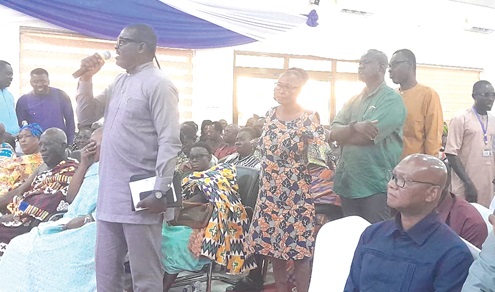
Stakeholders and residents in the Central Region have opposed proposals by utility providers to increase tariffs, describing them as excessive and insensitive to the economic realities facing citizens.
They questioned why utility companies were asking for tariff adjustments when service delivery remained unreliable.
The stakeholders, representing different shades of the public, including hoteliers, entrepreneurs, traders and artisans, made their point during a public forum organised by the Public Utilities Regulatory Commission (PURC) in Cape Coast, where major service providers, including the Ghana Water Limited (GWL), Electricity Company of Ghana (ECG), Ghana Grid Company (GRIDCo), and Volta River Authority (VRA) presented their 2025–2030 tariff proposals.
Utilities
Representatives of the utility companies proposed varying percentage increments to the stakeholders meeting, which was organised by the Public Utilities Regulatory Commission (PURC)in Cape Coast yesterday.
The proposal was, however, met with sharp criticism from the public, who argued that the increment was unjustifiable and would further burden already struggling households and businesses.
Speaking on behalf of the VRA, a Principal Engineer, Isaac Kojo Abban, said the authority currently charges 45 pesewas per kilowatt hour and was proposing an increase to 71 pesewas, a 59 per cent rise.
He explained that the increment would help the VRA replace ageing transformers at the Akosombo generating station and maintain power generation stability.
He emphasised that VRA’s transformers were not standard market products, but specially designed equipment that required significant investment.
A Market Operations Officer with GRIDCo, Linda Baah, also justified her company’s proposed 77.9 per cent increment, from 7.29 pesewas to 12.97 pesewas per kilowatt hour.
She said the adjustment would prevent overloading of transmission lines and transformers, ensure reliability of supply, and support maintenance works.
From the ECG, the acting Deputy Director of Commercial Services, Ebenezer Baidoo, revealed that the company was proposing a 27 per cent increment to support ongoing digitalisation efforts, pay debts owed to banks, and address losses caused by illegal connections.
He said the company had made major investments in meter installations and digital monitoring, but needed more resources to sustain service delivery.
The GWL, represented by the Chief Manager for CPME, Michael Tawiah Klutse, said the company’s operations had become expensive due to pollution, galamsey, and destruction of pipelines during construction projects.
He explained that dredging, which used to be done every 10 years, now had to be done quarterly because of siltation caused by illegal mining.
Participants
Some participants pointed out that government salaries and wages had not increased by even 10 per cent, making the proposed tariff hikes unrealistic.
Others also raised environmental and operational concerns, particularly against the GWL and the quality of water to customers.
They suggested the exploration of seawater desalination if it would prove a more sustainable and cost-effective water supply.
An entrepreneur and participant, Benedicta Addae, lamented that the proposed increases would cripple small businesses.
“These constant increments kill entrepreneurship and make it difficult for us to grow. People are slowly dying under these conditions,” she said, calling on the government to declare a state of emergency on illegal mining (galamsey) since its destruction of water bodies had become a major factor in rising utility costs.
Transparency, feedback
The Omanhen of Oguaa Traditional Area, Osabarimba Kwesi Atta II, called for balance between sustainability and affordability in setting utility tariffs.
He emphasised that water and electricity were cornerstones of life and development, but transparency in how tariffs were determined was equally vital.
“We all know production costs are rising, but this must not come at the expense of citizens’ well-being,” he said.
The Commissioner of the PURC, Kwabena Nyarko Otoo, said the commission valued the feedback from stakeholders and would carefully consider the concerns raised.
He admitted that while utilities required increased funding to sustain operations, the proposed increments appeared too high.
“We will review all submissions and forward our recommendations to the government,” he said, commending participants for their honesty and engagement.
He further echoed public calls for urgent action against galamsey, describing it as both an environmental and a public health emergency.
“We cannot continue to destroy the very water sources we depend on and expect lower tariffs; the fight against galamsey must be a collective one,” he concluded.
