
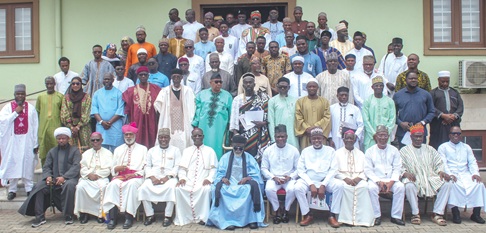
Discussants at an inter-faith dialogue have advocated the purging of the country's family value system and reasserting parental control as the first step in reversing the growing moral misbehaviour in educational institutions.
They said parents were failing in their basic responsibility of character formation at home and teachers' poor supervision were major contributing factors to the rise in violence and indiscipline in second cycle schools.
"Our family system is breaking down with little or no control by parents, which is escalated on campus by poor supervision and inadequate human resources to deal with the growing numbers of students," one of the four discussants, Rashid Ibrahim, a legal practitioner and member of the National Union of Ghana Students (NUGS), said.
He was part of a panel that discussed the topic, “Addressing the challenges of rising indiscipline in our school: The role of faith-based organisations”, at the 4th Catholic Bishops Conference and Office of the National Chief Imam Annual Dialogue at the National Mosque at Kanda in Accra yesterday.
The other panellists were the Secretary to the National Commission on Civic Education (NCCE), Lucille Hewlett Annang, a senior lecturer of the Department for the Study of Religions, University of Ghana, Legon, Rev. Professor Cosmas Sarbah, and a lecturer at the University of Ghana, Dr Haruna Saed.
It was attended by different religious bodies, including some members of traditional religion.
Corporal punishment
To reverse the current trend, Dr Saed also proposed that the government should give mission schools the free hand to have a major say in how the schools were run and institute their own way of instilling discipline.
For Rev. Prof. Sarbah, the current educational system was failing because it only focused on academic training to the neglect of character formation.
Ms Annang said the current economic condition was a major contributory factor since parents would have to leave home and return late with little or no control over the children.
However, the Minister of Local Government, Chieftaincy and Religious Affairs, Ahmed Ibrahim, who was the special guest of honour, had a different view.
He called for the reintroduction of corporal punishment in schools to reverse the trend.
Quoting extensively from the Bible and the Quran, the minister argued that corporal punishment was not outmoded but rather an action fully backed by the two holy books.
The Cs
An associate professor of tax law and policy at the University of Ghana School of Law, Prof. Adallah Ali-Nakyea, recommended the inculcation of what he described as the ‘Cs’– clarity, consistency, communication, caring and character– into the mainstream school system.
He said those traits were tested proof from research as key solutions to the current situation.
Among the solutions, Prof. Ali-Nakyea proffered were emphasis on moral and civic education, and promoting a peaceful co-existence among the various faiths on campuses.
The tax lecturer said students should be made to understand that differences in religious beliefs did not warrant conflict.
"School administrators, teachers and parents must chart a new pathway with the interest and character formation of students as paramount ingredients in their academic career," he said.
Speaking more on faith, with emphasis on the creation story as accounted in both the Bible and the Quran, the Chief Imam, Sheikh Osman Nuhu Sharubutu, and the President of the Catholic Bishops' Conference, Most Rev. Matthew Kwasi Gyamfi, said both Christians and Muslims were descendants of the Abrahamic bloodline, and differences in faith should not divide "us."
They said faith-based organisations had an indispensable role in shaping the lives of students and that role must not be neglected.
The two were of the view that respect for human dignity was the foundation of justice, peace and national cohesion, and the bedrock of responsible citizens.
They added that education was a shared responsibility of all stakeholders, especially between parents and teachers.
