
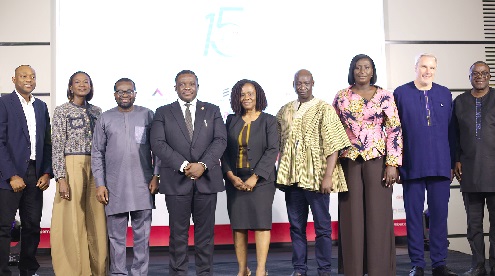
Telecom sector pillar of national development - Chamber CEO at 15th anniversary launch
The Ghana Chamber of Telecommunications (GCT) has launched its 15th anniversary celebrations with a renewed call for stronger collaboration and policy reforms to position the telecommunications sector as a key driver of national development.
The Chief Executive Officer (CEO) of the chamber, Sylvia Owusu-Ankomah, who made the call, said the nation’s telecommunications industry had evolved from a basic mobile connectivity platform into a critical national utility underpinning health care, education, governance and commerce.
“Networks we once thought were just primarily for voice and text are now carrying our entire national ambition. For that, I think that the chamber has to also pivot to support the national agenda and the transition of technologies and evolution that we see today,” she added.
The launch event held in Accra last Wednesday was in collaboration with the Global System for Mobile Communications Association (GSMA). It doubled as a one-day workshop for industry partners and stakeholders on the auctioning of the nation’s 5G spectrum and featured the unveiling of the anniversary logo.
Ms Owusu-Ankomah said Internet penetration in the country had increased from less than four per cent when the chamber was established in 2010 to about 70 per cent today, with mobile penetration nearing 100 per cent.
In that regard, she stressed the need for decisive implementation of the “dig once” policy to protect fibre infrastructure and reduce persistent fibre cuts affecting service delivery.
The CEO also underscored the importance of spectrum policy decisions, describing spectrum as a critical national resource that would shape the country’s digital competitiveness, investment climate, affordability and innovation in the years ahead.
Ms Owusu-Ankomah paid tribute to the founding leaders of the chamber for their roles in shaping the institution into a credible voice for the telecommunications industry. She also announced plans to reposition and rebrand the chamber to reflect the evolving digital ecosystem while preserving its institutional credibility.
Economic contribution
The Minister for Communication, Digital Technology and Innovations, Samuel Nartey George, said the telecommunications industry had become a major contributor to the country’s economy through job creation, tax payments and financial inclusion driven by mobile money services.
He also said the government would work with the National Communications Authority (NCA) to verify mobile subscription records and strengthen the country’s digital ecosystem through improved digital identity, payment and data exchange systems.
He also enumerated initiatives such as the One Million Coders Project and Girls in ICT programme aimed at promoting digital skills and inclusion, while stressing the need for improved rural connectivity, stronger cybersecurity, infrastructure sharing and better quality of service nationwide.
The Chairperson of the chamber, Stephen Blewett, said the industry was uniquely positioned to support the country in the next chapter on account that it had over the past 15 years.
“Invested billions into infrastructure, network spectrum, fibre, livelihoods and platforms that form the backbone of the digital economy.”
“These investments have created a foundation upon which emerging technologies such as AI can thrive.
The next 15 years will be faster, quicker, and more complex than the previous 15 years because the pace is improving and increasing all the time.
So we need more intentional support to protect and grow this industry,” he said.
Mr Blewett, who is also the Chief Executive Officer of MTN Ghana, stated that the industry must be protected from developments that could inadvertently destabilise the space or undermine the significant investments being made, adding, “It is definitely not about resisting change.
It's about shaping it responsibly”.
