
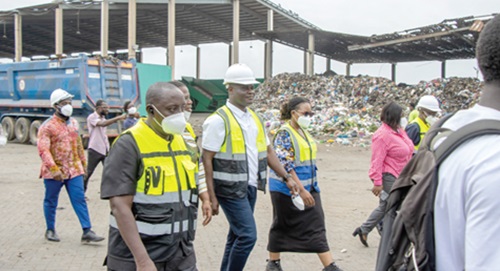
The Minister of Local Government, Chieftaincy and Religious Affairs, Ahmed Ibrahim, has given a firm assurance that the government will put in place a robust policy that leverages the potential of the private sector to solve the country's waste management challenge.
He said the strategy would formally integrate the six transfer stations owned by the Jospong Group of Companies (JGC) into the waste management ecosystem and also create more facilities to deal with the challenge as a national priority.
Mr Ibrahim stressed that having taken useful lessons from the flood disaster that struck the country on June 29, this year, the government was ready to address the structural and systemic challenges exposed by the downpour.
"President John Mahama directed that we must do everything to put in place systems that rally all strategic stakeholders to deal with waste management as a top priority, and that is what I will work hard to achieve as a minister," he stressed.
The Banda Member of Parliament (MP) stated this during a working visit to the Integrated Compost and Recycling Plant (IRECOP), one of the waste transfer stations operated by JGC in Accra last Monday.
Context
The downpour on June 29, 2026, saw the city of Accra submerged under floodwater.
The floods came with the destruction of property and loss of lives.
Following that disaster, President Mahama directed that all six waste transfer stations in the Greater Accra Region be opened to take care of the volumes of waste being evacuated.
He also declared a two-day nationwide flood aftermath clean-up exercise, rallying all stakeholders to save the country from waste.
The minister's visit to IRECOP was meant to assess how the facility was functioning and to learn at first hand the challenges that needed to be addressed to enhance waste management.
Good work
Mr Ibrahim said evidence on the ground had shown that with the exception of the Mallam facility, all the other five transfer stations located at Achimota, Ashaiman, James Town, Abokobi and Teshie were functioning optimally.
Based on the critical role the ZGC played in the management of waste in the aftermath of the disaster, the minister said he would engage all the government agencies to tap into the company’s potential in the waste sector.
“I will have to present a Cabinet paper and allow other ministers to make inputs.
As a country, we will have to mainstream transfer stations into our sanitation model.
“The good thing is that we have a company that can partner the government to rise to the occasion.
I want to thank JGC for the good they have done since this disaster struck.
"Sanitation is a shared responsibility involving the private and public sector, and we must work together to address our sanitation problems," he said.
