
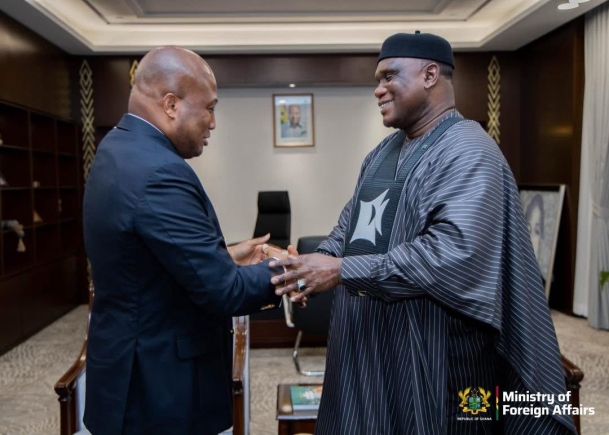
Ghana renews push for justice over killing of 44 Ghanaians in Gambia
Ghana and The Gambia have renewed discussions on efforts to secure justice for Ghanaian migrants killed under the regime of former Gambian President Yahya Jammeh in 2005.
The Minister for Foreign Affairs, Samuel Okudzeto Ablakwa, announced in a Facebook post on Sunday, May 17, 2026, that he had held bilateral talks with his Gambian counterpart, Sering Modou Njie.
According to Mr Ablakwa, the discussions covered cooperation in education, health, defence and support for Gambia’s foreign policy college.
He said the issue of accountability for the killing of more than 50 West African migrants, most of them Ghanaians, also came up during the talks.
The migrants were arrested by Gambian security personnel on July 22, 2005, after their boat landed in The Gambia while they were travelling towards Europe.
The migrants were suspected of involvement in a coup attempt against Jammeh’s government.
Over the following days, nearly all the migrants, including about 44 Ghanaians, nine Nigerians, two Togolese and nationals from Côte d’Ivoire and Senegal, were killed in The Gambia or taken across the border into Senegal where they were shot and dumped in wells.
Former members of Jammeh’s paramilitary unit, known as the “Junglers”, later testified before the Truth, Reconciliation and Reparations Commission that the killings were carried out on the orders of the former president.
One of the witnesses, Omar Jallow, told the commission that the leader of the operation informed the group that Jammeh had ordered that all the migrants be executed.
Findings presented before the commission described the killings as a state backed operation followed by an attempt to conceal the incident involving senior officials within The Gambia’s intelligence, military and police services.
Ghana attempted investigations into the killings in 2005 and 2006, but the then Gambian government reportedly obstructed the process.
A joint United Nations and ECOWAS report in 2009 later attributed the killings to rogue security officers acting independently, although subsequent testimonies and investigations challenged that conclusion.
On November 25, 2021, the commission submitted its final report to Gambian President Adama Barrow.
The report contained 427 findings and 218 recommendations and named several individuals accused of abuses during the Jammeh era.
The commission also concluded that there had been an organised attempt to cover up the killings.
Following the findings, the Gambian government on May 25, 2022 accepted recommendations to pay about 600,000 dollars in compensation to victims and their families through the governments of their respective countries.
Families of victims and survivors’ groups have since complained that they have not received the compensation and have not been formally contacted by Ghanaian authorities over the process.
Rights groups have also argued that the amount approved was inadequate considering the scale of the killings.
Mr Ablakwa also acknowledged the role Ghanaian troops played in stabilising The Gambia after the political transition that ended Jammeh’s 22 year rule.
Mr Njie, according to the Foreign Affairs Minister, expressed appreciation to Ghana and its military personnel for supporting democracy in The Gambia following the transfer of power to President Barrow.
