
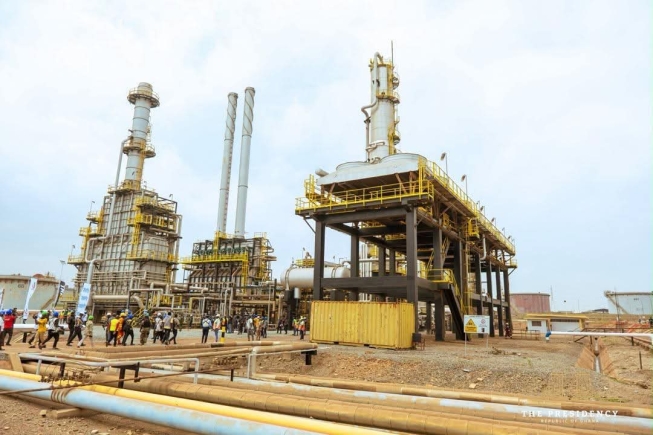
President John Dramani Mahama has declared that the successful revival of the Tema Oil Refinery (TOR) has demonstrated that strategic state-owned enterprises can be restored to efficiency, profitability and national relevance through visionary leadership, sound governance and dedicated human capital.
He said the return of TOR’s major processing units to operation had disproved the perception that state institutions were incapable of delivering results, reaffirming Ghana’s ability to rebuild and modernise critical national assets for economic transformation.
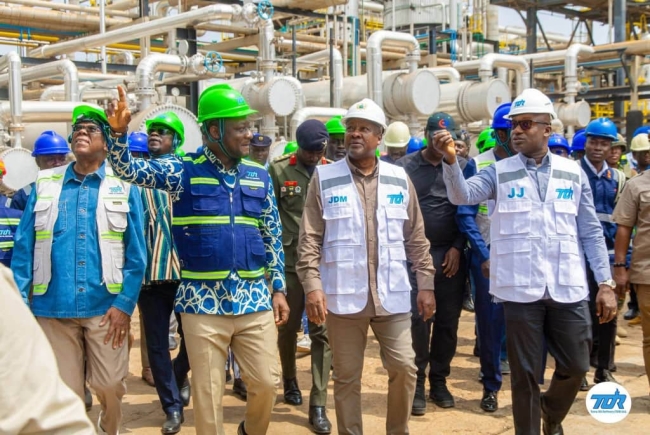
President Mahama made the declaration on Saturday at Tema when he commissioned the refurbished Crude Distillation Unit (CDU), the Residue Fluid Catalytic Cracking Unit (RFCC), a 120-ton steam boiler, a new F-61 Crude Heater and other upgraded facilities of Ghana’s only state-owned refinery.
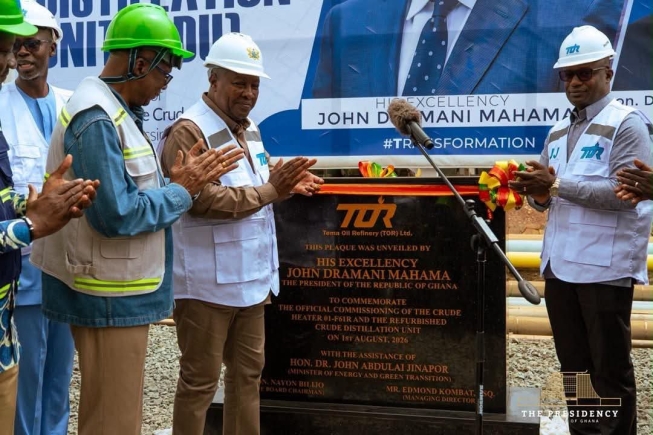
The ceremony also marked the official receipt of one million barrels of Ghana’s indigenous Jubilee Medium Sweet Crude delivered to TOR aboard the MT Apache for local refining.
“Today, we celebrate more than engineering success. We celebrate the resilience of a people who chose to rebuild rather than abandon an institution that continues to hold immense strategic value for our nation,” the President said.
He recalled that in December 2016, Ghana’s first cargo of Jubilee crude was delivered to TOR after the refinery had processed seven million barrels of crude into finished petroleum products, describing it as a demonstration of the country’s commitment to adding value to its natural resources.
However, he noted that the refinery later faced years of challenges, including halted production, debts and declining public confidence, leading to calls for it to be sold or abandoned.
“But I have always believed that nations do not build prosperity by abandoning strategic national assets whenever they face adversity. You do not sell your birthright because maintaining it has become difficult. You restore it. You strengthen it. You make it work again,” he stated.
President Mahama said the revival of TOR fulfilled a commitment he made during the last election campaign to restore the refinery to operation.
He disclosed that since May this year, TOR had received three one-million-barrel crude oil consignments, Bonga, Baleine and Jubilee Medium Sweet Crude, as part of efforts to restore domestic refining capacity.
He said the rehabilitation works had increased TOR’s processing capability from about 28,000 barrels per stream day towards its original design capacity of 45,000 barrels, with a pathway to achieving 60,000 barrels per stream day.
The President said a fully operational TOR would strengthen Ghana’s energy security, reduce foreign exchange expenditure on imported petroleum products, create jobs and increase value addition.
“Every barrel refined here means less foreign exchange spent importing finished petroleum products. Every young engineer employed here represents hope for Ghana’s industrial future,” he said.
He, however, cautioned management and workers that sustaining the gains required discipline, accountability and operational excellence.
“Reviving a refinery is one thing. Keeping it operating efficiently, safely and profitably is another,” he said.
The President praised TOR employees for preserving the refinery’s technical knowledge, equipment and future during years of uncertainty, charging the Board and management to ensure the facility remained competitive and commercially viable.
Expansion
To consolidate the gains, the President directed the Ministry of Energy and Green Transition and the refinery's management to develop a strategic plan to expand TOR's refining capacity to 100,000 barrels per day and implement reforms to insulate the refinery from political interference.
He said a stronger TOR would play a critical role in supporting the government's 24-hour economy programme and enhancing Ghana's competitiveness under the African Continental Free Trade Area (AfCFTA).
Earlier, the Minister for Energy and Green Transition, Dr John Abdulai Jinapor, said the President's decision to halt a proposed US$22 million lease arrangement under the previous government had saved the refinery and restored it as a strategic national asset.
Dr Jinapor further disclosed that President Mahama had directed a review of the payment system for crude oil supplied to domestic refineries.
He said that under the current arrangement, payments were made in foreign currency in line with existing petroleum revenue management provisions.
However, the President questioned why refineries that process crude locally and sell petroleum products in Ghana cedis should first purchase foreign exchange to make payments.
The Minister said the Governor of the Bank of Ghana supported the proposal, noting that reducing reliance on foreign exchange for domestic transactions could ease pressure on the cedi and reduce costs.
A meeting was expected to be held to explore a framework that would allow greater use of the Ghana cedi in domestic crude oil transactions.
Dr Jinapor said Ghana's ultimate goal was to achieve self-sufficiency in petroleum products and eventually export refined products to neighbouring countries.
He said the progress at TOR marked a significant step towards strengthening Ghana's energy security and restoring confidence in the country's industrial capacity.
Job creation
The Managing Director of TOR, Edmond Kombat, said the refinery’s restoration had created direct employment opportunities for 1,542 Ghanaians while rebuilding confidence in Ghana’s industrial capacity.
He said the revival was not only about rehabilitating ageing equipment but also restoring livelihoods, developing technical expertise and creating opportunities for young professionals.
“Today is therefore more than the commissioning of equipment. It is the commissioning of confidence. It is the restoration of national pride,” he said.
Mr Kombat said the completion of the CDU Turnaround Maintenance and the resumption of refining operations on December 19, 2025, marked a major turning point in TOR’s recovery journey.
He said other milestones included the installation of Furnace F-61, rehabilitation of Boiler Number Eight and the new 120-ton steam boiler, completion of outstanding audited accounts and the processing of indigenous Ghanaian crude oil.
He disclosed that TOR returned to profitability, recording a Profit Before Tax of more than GH¢1 billion for the 2025 financial year, due to improved financial discipline, operational efficiency and reduced receivables.
Mr Kombat said 301 temporary workers were engaged during the CDU maintenance, while another 287 were recruited for the RFCC maintenance. He added that 35 local subcontractors employed 654 temporary workers, while 300 young engineers were recruited into permanent positions.
He said TOR’s ambition was to become one of the most competitive refineries in West Africa by expanding capacity, modernising facilities and strengthening operational efficiency.
“Energy security cannot operate on office hours. Every additional hour of refining strengthens Ghana’s economy. Every additional litre produced locally reduces dependence on imports,” he said.
