
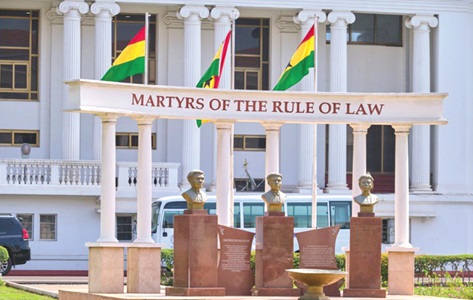
The Supreme Court of Ghana issued two landmark decisions on Wednesday, July 29, each with far-reaching consequences for different pillars of the country's democratic architecture.
The first ruling struck down the delegate system long used by Ghana's political parties to elect flag bearers and other party officers.
The second ruling upheld the constitutionality of the Office of the Special Prosecutor (OSP) Act, 2017 (Act 959), an outcome that anti-corruption advocates will greatly celebrate.
I welcome these rulings and here is why.
Unconstitutionality of the delegate system
I have long advocated a system of open primaries in which every registered member of a political party in good standing is allowed to vote in internal party contests.
My position was never a constitutional argument, but a pragmatic one — shaped by hearing stories of the power of delegates and allegations of the use of monetary and non-monetary inducements to secure their votes.
I solidified my view after a good friend, who I believed was the stronger candidate for a parliamentary seat, lost the internal party contest for obvious reasons.
To their credit, the political parties have, over the years, expanded the pool of delegates who vote to elect flag bearers and parliamentary candidates.
But that expansion never extended to include every registered member.
This ruling now pushes them to close that gap.
What I particularly like about the ruling is its potential to raise the cost of using monetary and non-monetary inducements in internal party elections.
It is far cheaper to induce a few hundred delegates than an entire constituency of registered members.
I don't imagine money will ever be fully absent from electoral contests — but I am betting that this higher cost will shift the incentive structure, pushing candidates to compete more on the strength of their ideas than the depth of their pockets.
This ruling, however, places an administrative and, especially, financial burden on political parties to comply, given the effort required to organise internal elections open to full membership.
Perhaps, it is time to revisit the question of state financing for political parties — not necessarily as direct monetary support, but as in-kind support, where the Electoral Commission, for example, absorbs the cost of holding internal elections open to all registered party members.
Constitutionalityof the OSP Act
Campaigning as a strong anti-corruption candidate, former President Nana Addo Dankwa Akufo-Addo promised to create a new anti-corruption agency — the Office of the Special Prosecutor — with the independence and resources needed to fight corruption, in my words, without fear or favor.
He not only followed through by ensuring passage of the legislation that created the office, but the first Special Prosecutor he appointed came from a rival political party.
This demonstration of commitment was met with great applause from anti-corruption advocates.
It was,therefore, odd that, over the years, the side of the political aisle that promised and delivered the office no longer seemed to feel warmly about it, as I have often described it — while the side that never promised it appeared ready to dismantle it, at one point through a private member's bill that was later withdrawn.
I applaud the court's decision because we have often argued, in public discourse, that an Attorney-General lacks the full independence needed to pursue corruption cases — especially those involving in-regime corruption — leaving a major gap in the country's efforts to fight corruption in government.
This ruling gives some assurance that the OSP can fill that gap.
That said, while I applaud the court's decision upholding the constitutionality of the Act, I worry about the caveat reported in the media: that while the OSP retains the power to prosecute, the Attorney-General retains the power to enter a nolle prosequi and terminate cases the OSP has filed.
Though certainly not the ruling's intent, I wonder whether it creates a perverse incentive for an Attorney-General to interfere — using that constitutional power — with OSP prosecutions, particularly those involving fellow government, cabinet, or party members.
Should that happen, the ruling could unintentionally weaken the very office it is meant to protect.
This is where political accountability by citizens becomes essential.
If an Attorney-General attempts to interfere with OSP cases that have a legitimate basis for prosecution, citizens can bring political pressure to bear — pressing the appointing authority to remove them or voting their party out of office at the next election.
Conclusion
Taken together, the two rulings are significant because one reshapes how democracy is practiced within the structures of our political parties, while the other upholds the constitutionality of a critical pillar in the country’s anti-corruption architecture.
The writer is the Project Director, Democracy Project.
