
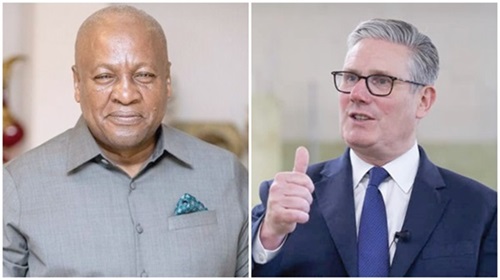
Keir Starmer’s fall from grace: Lesson for President Mahama?
Unless you have been out of touch with international news, you will know that the United Kingdom – once regarded as a bastion of political stability – is now widely regarded as ‘ungovernable’.
Why? Because the apparently set-in-stone two-party system – dominated by the Conservative and Labour Parties for four decades – has spectacularly collapsed.
Combined, both parties get the support of only one-third of voters. UK politics now features seven parties with significant levels of popular support. Prominent among them is the Reform Party, a right-wing populist party, whose leader, Nigel Farage, was until recently one of Donald Trump’s favourite people.
Starmer’s challenge
As I write this article on Friday, May 15, there is a very strong chance that the UK Prime Minister, Keir Starmer, will be challenged for the leadership of the Labour Party by several competitors from both the left and the right. Analysts predict that a prolonged leadership race will plunge the UK into chaos, lead to economic deterioration, and undermine its global position.
In the UK, Prime Minister Starmer faces intense public and political scrutiny: 70 per cent of the British public think that he’s doing badly as prime minister – and just 19 per cent have a positive opinion of him overall.
Mahama’s popularity
Are there similarities between Prime Minister Keir Starmer and President John Dramani Mahama? Unlike Starmer, President Mahama retains strong public support, with a 67 per cent approval rating, according to a March 2026 poll by Global InfoAnalytics.
The survey showed that only a quarter (26 per cent) of voters disapprove of his performance, albeit a slight increase from 24 per cent recorded in December 2025.
Two-thirds of those polled by Global InfoAnalytics believe that Ghana is headed in the right direction under President Mahama.
Fewer than a third (28 per cent) believed that the country is on the wrong path, up from 24 per cent three months earlier.
But optimism about the future has dipped slightly.
The Global InfoAnalytics poll found that 68 per cent of voters expect their standard of living to improve over the next 12 months, down from 70 per cent in the previous quarter, suggesting growing unease over potential inflationary pressures linked to the Middle East conflict.
challenges
Compared to the UK, which has faced major economic challenges in the last few years, linked to both national and international factors, Ghana is riding high.
Inflation is down to 3.4 per cent, and the International Monetary Fund says the economy will grow by almost five per cent this year.
Yet, many Ghanaians don’t feel well off, making careful calculations about budgetary considerations before spending cedis in the market.
Many potential customers are bargaining like crazy, and if the price is not right, not buying.
So, here’s the paradox: on paper, the economy looks great; on the ground, progress is disappointingly slow.
If this disconnect persists, President Mahama’s popularity is likely to decline and, with the next general election only two and half years away, things might get tough for the NDC when trying to ‘sell’ its next presidential candidate in the face of no doubt strong electoral pressure from the NPP and other opposition parties.
President Mahama’s high approval ratings come in the face of criticism over a range of national concerns: Why is illegal gold mining - galamsey - still uncontrolled?
What’s going on with the crucial cocoa sector?
What of the allegedly broken electoral promises? Why the major reported financial losses linked to state institutions?
What’s the government doing about rising unemployment, unposted essential workers, and delayed payments affecting teachers and nurses?
It will be recalled that in December 2016, the NPP won the presidential and parliamentary elections and many Ghanaians were optimistic that President Akufo-Addo would rule both wisely and well, to usher in a new era of prosperity, stability and peace. Instead, after two terms in office, Ghana had seen serious economic decline, including high international debt and sky-high inflation, a persistent failure to tackle galamsey, numerous high-profile corruption scandals, and failure to fulfil promises regarding the size of government.
Lessons
President Mahama’s government is approaching the halfway point in its four-year tenure. Like Prime Minister Starmer, President Mahama took office after a landslide win.
It is possible that both men enjoyed major electoral success not only because of their own or their party’s qualities, but also because incumbent governments in both the UK and Ghana were so unpopular: throw the rascals out!
Things unravelled very quickly for Keir Starmer, giving rise to claims that the UK is now ungovernable.
President Mahama might do well not to regard the Starmer debacle as a sideshow happening far away from Ghana.
Instead, it might be useful to understand Prime Minister Starmer’s rapid and apparently terminal fall from political grace as a salutary lesson in what can happen when public opinion pivots decisively against the national leader because of perceived inadequacies, limitations or shortfalls.
The writer is Emeritus Professor of Politics, London Metropolitan University, UK
