
More constitutional reforms?
It was not uncommon for all the “ills” of Ghana’s democracy to be blamed on the constitution.
In engagements with friends and colleagues, the view was that constitutional reforms are key if Ghana’s democracy wants to continue making any meaningful progress.
There were some who held the radical view that a completely new constitution was the answer.
Between these two extreme views (new constitution vs reform) was a recognition that Ghana’s constitution needed some important changes.
The efforts
In the lead-up to the 2024 elections, there was a commitment by then-candidate and now President, John Mahama, to constitutional reforms.
In fulfilment of that promise, and upon assumption of office, he appointed Prof. H. Kwasi Prempeh to chair a constitution review committee.
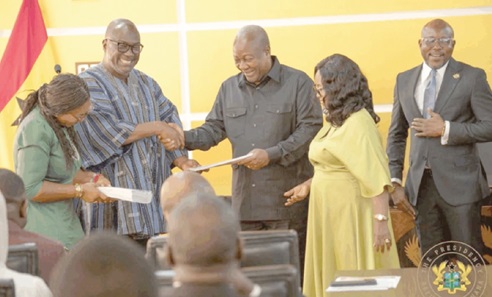
After several months of public engagement across the country, the committee presented its report to the President.
The summary recommendations were immediately shared with the public.
The full comprehensive report that followed is yet to be shared publicly.
That notwithstanding, the first phase of the work is complete and with a comprehensive set of recommendations awaiting the next phase – implementation.
During the presentation of the report, it was clear that the President remained committed to constitutional reforms.
He received the report well, promised to study it, and further promised to move to the next phase - implementation.
It was reassuring because we are all too aware of the fate that met a previous attempt at comprehensive constitutional reforms.
The year 2026 is five months old.
The question on my mind is where we are today with constitutional reforms because the public space is quiet and there is no word from officialdom regarding the next steps.
Unless the next phase of the process is happening quietly out of the public eye.
But then, given the public interest in constitutional reforms, judging from the participation during the different regional forums, it is very difficult to accept that the next phase of the work is being done quietly.
If not now, then when?
Ghana, undoubtedly, has made great progress when it comes to our democratic journey since the 1992 transition.
If for nothing at all, the country has enjoyed thirty-three years of uninterrupted multiparty democracy when placed within the context of prior failures (1969-72 and 1979-81).
While the intent here is not to be dismissive of this unique period in our post-independence political trajectory, there is also no denying that Ghana’s democracy faces some key challenges and new threats.
These challenges and new threats are well captured in various democracy and good governance surveys and indices.
The information from these sources is one of the incentives we need to engage in constitutional reforms.
Which is why I ask – if not now, then when?
If constitutional reforms won’t proceed now, when we have moved from being a liberal democracy to an electoral democracy (V-Dem classification) or when Afrobarometer shows deteriorating trust and increasing perceptions of corruption in key democratic institutions, then what other time will be best suited for reforms?
Are we waiting for our performance on democracy and good governance metrics to further deteriorate before we move ahead and engage in meaningful constitutional reforms?
Ghana’s democracy has witnessed four electoral turnovers, but none has produced the kind of outcome seen in the 2024 general elections with respect to composition of parliament.
The economic and governance environment in the lead-up to the election pointed to an electorate disenchanted with the incumbent.
Voters delivered an unambiguous verdict about how they felt and gave a clear mandate to the current government.
Is the current government willing to spend some of the political capital from the 2024 electoral mandate on constitutional reforms?
One would hope so because I am not sure how soon another turnover election will give an incoming government this type of electoral mandate.
The President framed both his 2024 election campaign and second presidency as an opportunity to “reset” the country.
The opportunity to “reset”, in my opinion, is broader than the efforts being made to both stabilise and grow the economy.
It equally requires attention to the governance architecture of the country, which makes this time an opportune one to pursue constitutional reforms.
Given the President’s commitment demonstrated through the setting up of the Prof. H. Kwasi Prempeh Committee plus the “reset” agenda, I am worried a stalling of efforts to reform the constitution will be a missed opportunity.
Lastly, the people of Ghana. Anyone who followed the work of the constitution review committee will admit that the public engagements pointed to a strong citizen interest in constitutional reforms.
I am not sure citizens will rally around constitutional reforms again with the same level of energy if nothing is done this time.
That is why I ask again, if not now, then when?
The writer is Director, Democracy Project
