


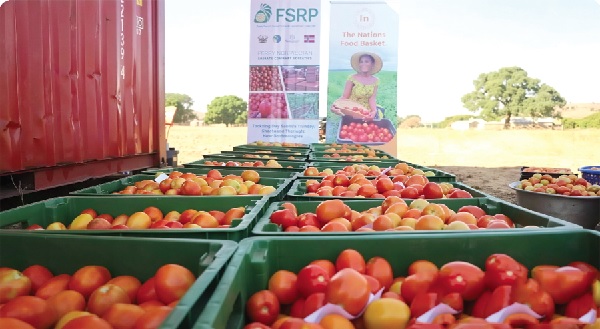
Attaining tomato self-sufficiency: Invest in irrigation, processing infrastructure • Analysts urge urgent action
The closure of Burkina Faso’s borders to tomato exports has exposed Ghana’s heavy reliance on imports, with farmers calling on the government to prioritise investment in tomato production and processing to ensure food security.
Two persons associated with the agricultural value chain, Dr Charles Nyaaba and Edward Kareweh, said the country had the capacity to be self-sufficient in tomato production and even export and called for action now to make that happen.
They cited major growing areas such as Akumadan, Techiman, Navrongo, Pwalugu and other parts of the Upper East Region.
The Volta Region, which has high horticultural productivity, also has large-scale tomato cultivation that should be ramped up and made to grow year-round.
Dr Nyaaba, a former director of the Peasant Farmers Association of Ghana (PFAG), in an interview with the Graphic Business, urged the government to create an enabling environment for private-sector participation in processing, improve irrigation infrastructure, provide access to quality seeds and upgrade feeder roads in farming communities.
He dismissed claims that locally produced tomatoes were inferior or more expensive, insisting that increased production would stabilise prices and make them competitive.
Dr Nyaaba linked the current challenges and the imminent shortage to past policy failures, especially the processing factories' inability to absorb produce, explaining the decline in local production of the staple.
He recalled that in 2008, farmers were encouraged to increase tomato production following assurances that the Pwalugu Tomato Factory would be revamped.
“After harvest, the factory could not even take five per cent of the produce. Tomatoes are highly perishable, and within weeks, farmers recorded massive losses,” Dr Nyaaba recalled.
The situation, he said, led to widespread loss of confidence in tomato farming, forcing many producers to switch to other crops such as rice and pepper.
Dr Nyaaba further criticised the overreliance on imports, describing it as a short-term measure that had weakened the local industry over time.
Irrigation system
In a separate interview, Edward Kareweh, a former General Secretary of the General Agricultural Workers Union (GAWU), called for urgent investment in irrigation and tomato-processing facilities to address recurring supply challenges in Ghana.
He said the country had the capacity to produce enough tomatoes but was constrained by poor irrigation systems and weak agro-processing infrastructure.
“The northern part of Ghana can produce enough tomatoes, but the lack of irrigation limits year-round farming,” he said, adding that the absence of functional processing factories had discouraged farmers, leading many to abandon tomato cultivation.
“In the past, farmers produced in large quantities, but without processing facilities, their efforts collapsed. That is why many have shifted to other crops,” Mr Kareweh corroborated the position of Dr Nyaaba.
He stressed the need for the government and private-sector investment in processing plants, arguing that aligning production with processing demand would ensure sustainability.
“If we invest in processing and guide farmers on the right varieties, Ghana can meet its needs and avoid such crises,” Mr Kareweh said.
New development
The Ministry of Trade, Agribusiness and Industry, in a statement issued last Friday, said the government, through the ministry and other relevant state institutions, would engage authorities in Burkina Faso over the decision to ban the export of fresh tomatoes.
The engagement would be to address concerns about the ban and chart a mutually beneficial way forward for both countries.
The government reiterated its commitment to working with stakeholders to boost local tomato production under the "Feed Ghana" and "Feed the Industry" programmes, aimed at increasing output to meet domestic demand.
Background
A directive issued by Burkina Faso’s Commerce Minister, Serge Gnaniodem Poda and Agriculture Minister, Ismaël Sombié, on March 16, 2026, suspended all fresh tomato exports from Burkina Faso, affecting supplies to Ghana.
Ghana imports over $400 million worth of tomatoes annually from Burkina Faso.
The nationwide suspension also halts Special Export Authorisations. Traders with permits were given two weeks to complete existing shipments before approvals would be revoked.
Authorities said violations would attract sanctions, with seized produce sent to local processing plants.
The move is part of Burkina Faso’s plan to expand domestic tomato processing, including a plant in Dogona and another in Tenkodogo, which is expected to open this month.
The decision also comes after a February attack in Titao that killed seven Ghanaian traders.
A recent report by the Chamber of Agribusiness Ghana (CAG) estimates that Ghana spends about GH¢760 million annually on tomato imports, including paste and over 75,000 tonnes of fresh tomatoes.
While imports from Burkina Faso alone were valued at GH¢400 million in 2022, the CAG says total value chain losses could reach GH¢7 billion, including tax revenue, post-harvest losses, wages and security costs.
Ghana’s reliance on Burkina Faso for tomatoes highlights structural gaps in irrigation and agro-processing.
While regional trade under the Economic Community of West African States (ECOWAS) has supported supply, the export ban exposes risks of overdependence.
Burkina Faso’s shift towards domestic processing reflects a broader regional push for value addition.