


Farmers welcome government’s move to prioritise local rice
FARMERS have welcomed the government’s decision to prioritise locally produced rice and beans in public schools, describing the step as a major boost for local production.
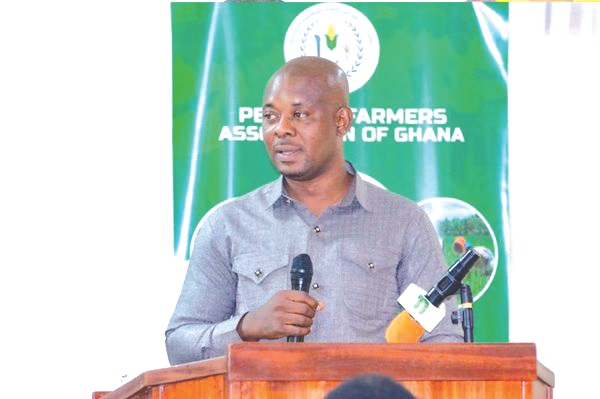
The President of the Peasant Farmers Association of Ghana (PFAG), Weipa Addo Awal, said the policy answers weeks of appeals from smallholder farmers who have been struggling to sell surplus food.
He said the announcement in the 2026 Budget signals a practical response to the long-standing challenge of unsold rice and beans on farms across the country. According to him, the additional GH₵200 million earmarked for food purchases strengthens farmers’ confidence in the new approach.
“This is commendable and we see it as a strong start,” he said.
Budget reading
Mr Awal said the budget offered a clear signal that the government is beginning to respond to farmers’ concerns raised over the past months.
He revealed that the commitment to buy surplus rice and beans, the GH¢ 200 million allocation for food purchases and the renewed attention to irrigation and mechanisation showed a shift toward practical support for local producers.
He added that while the policy direction is encouraging, its impact will depend on how quickly the measures are implemented and how transparent the process becomes.
“The budget is a good start, but we want to see real action on the ground,” he said.
Mr Awal said farmers now need clear timelines on when buyers will visit producing communities.
He explained that contractors working under Buffer Stock Company must make public the regions assigned to them and confirm when they intend to purchase from farmers.
He said this information is key because many farmers lose money when buyers delay or fail to show up.
He warned that the policy will struggle to deliver the expected results.
“We want to know who is buying, where they are buying and when they are coming,” he said.
Broader coverage
Mr Awal said the policy should not stop at public schools.
He called for an extension to prisons, hospitals, the military and all other public institutions that purchase rice and maize in large quantities.
He said the Association has the capacity to supply these institutions once government provides accurate consumption data for the various sectors.
With proper information, he said, farmers can scale up production to meet national demand.
“We only need the data on how much they consume so we can produce accordingly,” he said.
He expressed concern about the lack of stronger border controls, saying the market continues to be flooded with cheap and inferior imports.
He warned that these imports distort prices and make it difficult for local farmers to compete.
He said the situation also leads to revenue losses for the state because goods enter without proper checks.
Tightening entry points, he noted, would help protect local produce and support the broader aims of the budget.
“Our borders are porous and that makes the market unfair for local farmers,” he said.
Mechanisation
He further welcomed the budget’s focus on farmer service centres, saying access to machinery remains one of the biggest challenges for smallholders.
Many farmers, he said, still struggle to secure tractors, combined harvesters and other implements.
He said the Association will monitor implementation closely to ensure the centres are set up as promised.
“The centres are important to reduce the burden on farmers,” he said.
The PFAG President also commended the plan to construct solar-powered boreholes for irrigation but urged the government to revisit dams built under the One Village One Dam programme.
He said many of the dams failed to hold water because of poor planning and weak consultation.
He said a proper review and reconstruction would strengthen resilience in the face of climate change and ensure the gains from the budget reach farmers.
“We want all policies to reflect what is happening on the ground so they truly benefit farmers,” he said.