


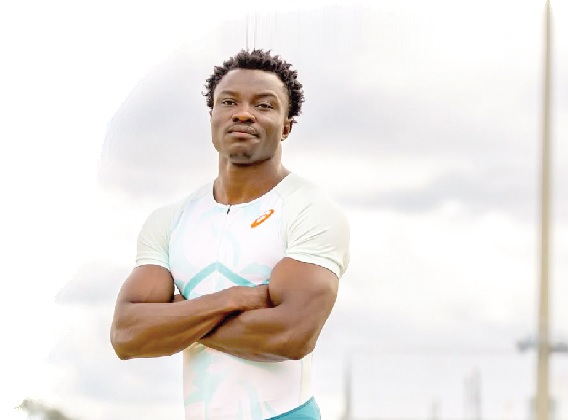
Saminu’s ASICS deal is blueprint for Ghanaian athletics success
When Ghana’s national 100-metre record holder Abdul‑Rasheed Saminu signed a three-year professional endorsement deal with Japanese sportswear brand ASICS last week, on the surface, it may have looked like a straightforward sponsorship announcement. In substance, however, it illustrates a deeper point about how elite sport is financed, managed and sustained.
Running retrospectively from October 2025 to December 2028, with an option for 2029, the agreement places Saminu firmly on the professional circuit at a decisive stage of his career.
Holder of Ghana’s men’s 100m record at 9.84 seconds and widely regarded as Africa’s third fastest man over the distance, he is now structurally equipped to pursue longer-horizon objectives, notably the 2027 World Championships and the Los Angeles 2028 Olympic Games.
What distinguishes the ASICS deal is not its branding value but its architecture. In addition to performance footwear and apparel, the agreement covers travel, coaching allowances and physical therapy—inputs that, in elite sprinting, tend to be decisive rather than discretionary. For athletes operating at the margins of world-class performance.
For the Ghanaian athletics ecosystem, which has often struggled to convert early promise into durable professional success for athletes, Saminu’s deal represents a case study in how structured, elite-level sponsorships can unlock both competitive and commercial value.
It underlines a simple but often ignored reality: raw talent alone is insufficient without the systems that allow that talent to mature.
Structure over cash benefits
Globally, leading brands now combine capital with access to sports science, medical services, competition planning and research-led product development.
For athletes from countries like Ghana, without fully resourced national high-performance systems, such arrangements effectively substitute for state-backed infrastructure.
They provide continuity of coaching, predictable competition pathways and professional management—elements that are often fragmented or absent in emerging sporting economies.
Equally important is access. Sponsored athletes benefit from integrated training environments, global competition pathways and professional management structures that allow them to focus exclusively on performance.
Proven pathways for Ghanaians
Saminu’s trajectory mirrors that of fellow Ghanaian sprinters Benjamin Azamati and Joseph Paul Amoah offer recent examples of how structured sponsorship can accelerate progression.
Azamati, Ghana’s former 100m record holder, signed what was widely described as a lucrative ASICS Global endorsement in 2022.
At the time, he spoke openly about the value of having a partner that nderstood his technical and professional needs.
Access to advanced footwear technology, competition exposure and structured planning allowed him to transition confidently from collegiate athletics into the global elite.
Although Azamati has since moved on to a new sponsorship cycle with another brand, his ASICS period was pivotal in establishing him as a world-class sprinter.
Similarly, Amoah, Ghana’s 200m national record holder, secured ASICS backing after his 2022 Commonwealth Games breakthrough. Just as in Azamati’s case, the sponsorship deal functioned less as marketing and more as providing stability at a stage when many African athletes struggle to maintain momentum after major breakthroughs.
Saminu’s agreement follows this pattern and reinforces why the former University of South Florida athlete’s future now appears particularly bright, as he enters his prime with a comprehensive support system already in place.
Post-college discontinuity
The significance of such sponsorships becomes clearer when set against the structural challenges confronting Ghanaian athletes, especially those emerging from the NCAA system in the United States.
Under collegiate scholarships, athletes enjoy world-class coaching, medical care, sports science, nutrition and competition schedules, often at no personal cost.
The problem arises after graduation. Many athletes fall off a developmental cliff as that support vanishes overnight.
Without immediate professional sponsorship or backing of national federations, several promising Ghanaian athletes have faced a sudden loss of coaching continuity, medical oversight and financial stability.
Many of such promising athletes prematurely called time on their careers due to challenges in transition into full-time professional sport due to the struggle to self-fund training and competition at the level required to remain internationally competitive.
ASICS’ long-term commitment to athletics, including its decade-long partnership with World Athletics, positions the brand at the centre of the global track and field ecosystem. Sponsored athletes like Saminu benefit from exposure at premier events and integration into a network that spans World Championships and Olympic cycles.
Alongside corporate investment, institutional mechanisms are beginning to play a more visible role. In recent years, the Ghana Olympic Committee has expanded its use of Olympic Solidarity scholarships and targeted athlete-support programmes aimed at major international competitions.
The GOC recently funded advanced training programmes in Europe for athletes like Elizebeth Serwaa Oduro (Judo) and Henrietta Naa Ayele Armah (Taekwondo) targeting the 2028 Olympics.
Saminu’s ASICS deal is, therefore, a structure that needs replication across disciplines and supported by coherent national frameworks to ensure that Ghanaian athletes compete favourably at global levels.