
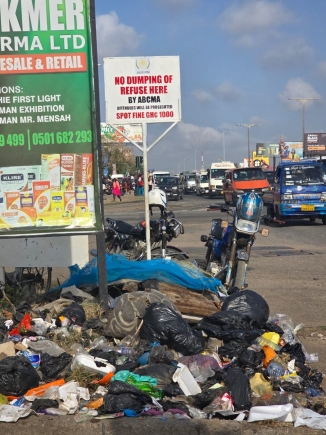
Globally, a person produces, on average, 0.74 kg of waste every day but developed countries are known to often produce more waste than developing nations.
On the other hand, it is estimated that each person in Ghana produces an average of 0.47 kilogrammes (kg) to 0.74 kg of waste every day, depending on the area, with the figure being higher in metropolitan areas such as Accra.
According to a United Nations Development Programme (UNDP) 2022 report, about 12,710 tonnes of solid waste were generated every day, with only 10 per cent collected and disposed of properly.
All the uncollected waste ends up in open spaces such as the streets, gutters and drains, rivers and the sea, or is disposed of through open burning, thus polluting the environment.
Already, the country is faced with the challenge of disposing of the waste generated daily because we are not able to match the rate of generation, while many waste management companies are struggling to stay in business.
Also, several waste management facilities, including landfill sites, solid waste treatment plants and wastewater treatment facilities, are struggling to remain operational due to the rising costs of fuel, electricity, labour and maintenance.
Some waste management companies have turned to tricycles, commonly referred to as ‘aboboya,’ for the collection of waste from hard-to-reach areas, especially in urban areas.
Albeit, the capacity of these tricycles, which are often overloaded and end up strewing waste along the way, is so small that most households are forced to keep their waste for several weeks, or openly burn it.
Last week, the Environmental Service Providers Association (ESPA), made up of waste management companies and other sanitation service providers, held a press conference, where they appealed to the government to settle outstanding payments owed them by November 7, this year, to save them from a total nationwide shutdown.
Although they fell short of telling the press how much they are owed by the government represented by the Local Government Ministry, which is in charge of the country’s sanitation, we dare say that the amount owed must be quite substantial, having piled up for a long time (up to three years), for the waste stakeholders to put in the appeal and threaten a total shutdown, should their plea go unhindered.
As indicated by the Executive Secretary of ESPA, Ama Ofori Antwi, at the press conference, members of the association were at the crossroads due to the severe operational and financial distress confronting the waste management sector.
The Daily Graphic knows that waste management everywhere is treated as a public good with heavy governmental support because it is a capital-intensive venture which requires equipment that is very expensive, such as the compactor truck, and waste treatment facilities.
We shudder to think of what would happen in the country should the ESPA and its membership go through with their threat if the government becomes adamant.
As explained by the service providers, the fees received from the metropolitan, municipal and district assemblies (MMDAs) are even inadequate and do not cover the costs of the service rendered, so not paying the already insufficient fees only portends disaster – a sanitation emergency that could lead to the outbreak of diseases such as cholera, typhoid and malaria.
We find the situation of the environmental service providers dire and urge the government, through the Ministry of Finance, to come through speedily to save us all from the sanitation emergency that looms.
Indeed, there should be a dedicated fund to support and sustain waste management infrastructure so that we do not revisit this unpalatable situation that stares us in the face over and over again.
We might want to look at reviewing the Sanitation and Pollution Levy as suggested by ESPA, to make this happen.
The Daily Graphic believes that if our MMDAs fix fees that ensure full cost recovery during their annual fee-fixing resolutions, it will ensure the sustainability of waste collection operations.
Let us not treat waste management as business as usual; else if the few private companies which have ventured into assisting us to have sane and sanitary environments, throw in the towel, the consequences will be dire.
