
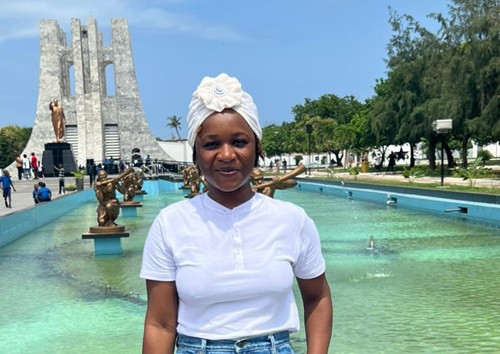
I am Huzeima Mahamadu, a Ghanaian PhD candidate at the Australian National University, Australia. My research project, “The Politics of Difficult Heritage in Museums: Slavery History in Ghana,” examines how slavery is interpreted and presented in Ghanaian museums and how diverse audiences engage with these narratives.
With the support and approval of the Ghana Museums and Monuments Board (GMMB) and its staff, I have been in Ghana conducting fieldwork, engaging with GMMB and its museum educators, local Ghanaians, the African diaspora (including African Americans, Afro-Caribbeans, Afro-Europeans, and Afro-Brazilians), and international visitors. I particularly welcome Afro-Brazilians in Ghana or those who have visited the slave dungeons to connect with me, as this group has been more difficult to reach.
The African diaspora represents the living legacy of enslavement, the displaced families of continental Africans. Their ancestors endured profound inhumanity: As free people living their lives in Sub-Saharan Africa, they were captured through violence, marched over long distances to coastal forts and dungeons, forcibly transported across the Atlantic, and enslaved on plantations in the Americas. They were treated as property, denied rights, subjected to brutal punishment, deprived of wages and ownership, and controlled through violence for generations. The legacy of this system extended far beyond slavery itself, contributing to racism, colonisation, neocolonialism, and ongoing discrimination against Africans and people of African descent. Recognising enslavement as a crime against humanity is therefore both justified and necessary.
In this regard, I commend Ghana, President John Dramani Mahama, African Union member states, Caribbean nations, and all who supported the recognition of enslavement as the “gravest crime against humanity.” This acknowledgment is long overdue.
It is essential to state that this crime was perpetrated against Sub-Saharan Africans largely by some European countries. While some African chiefs and merchants participated, a role acknowledged and apologised for by the Ghana National House of Chiefs, this involvement must be understood within its historical context. European coercion, deception, the introduction of firearms, and the manipulation of local alliances significantly intensified conflicts and the scale of capture. This was not a system of equal exchange; it was deeply exploitative and unequal. While a few individuals may have benefited, the vast majority of societies across Sub-Saharan Africa and Ghana suffered devastating losses.
Families were violently separated, and the persistent threat of abduction disrupted economic activities, social systems, and cultural continuity. These consequences did not end with the abolition of the Trans-Atlantic Slave Trade; they evolved into colonisation, neocolonialism, and enduring racial inequalities, and shaped global perceptions of African peoples to this day.
Despite this shared history, many Ghanaians do not fully appreciate their connection to the African diaspora as extended families separated by force. This gap persists due to limited, deliberate engagement with this history. Without such awareness, it becomes difficult to draw lessons that can inform present actions and future development across Africa and among people of African descent.
Therefore, beyond recognising enslavement as the ‘gravest crime against humanity,’ the government has a responsibility to ensure that such injustices never recur. A critical step is for the Ministry of Education and the Ghana Education Service to make history education relevant and age-appropriate at various educational levels. History could be compulsory at the senior high school level, regardless of academic specialisation. This education should extend beyond classroom instruction to include experiential learning such as visits to slave markets, castles/dungeons, and sites of resistance. A comprehensive curriculum should cover pre-15th-century Ghana, indigenous systems of servitude, the Trans-Saharan trade and slavery, European arrival, and the full structure of the trans-Atlantic slavery, from capture and internal transport to coastal detention, forced transportation across the Atlantic Ocean, and plantation labour in Brazil, the Caribbean, and America. It should also include abolition, colonisation, the struggle for independence, the evolution of the African diaspora, and contemporary Ghana.
Equally important is an emphasis on the enduring legacies of enslavement, including racism, economic inequality, neocolonialism, and modern forms of exploitation. Students must also be encouraged to reflect on the responsibilities of Africans today in preventing similar vulnerabilities in the future.
The media has a crucial role to play in this process. By engaging historians and scholars, media platforms can deepen public understanding of history and connect past experiences to present realities, offering insights that can guide national and continental development.
Institutions such as the Ghana Museums and Monuments Board should collaborate with educational institutions and media organisations to promote public engagement with historical monuments and museums. Through documentaries, storytelling, exhibitions, and guided tours of historical sites, they can make history accessible, relevant, and impactful, helping citizens understand both the past and its implications for the future.
At the societal level, individuals must also take responsibility for learning their history and recognising its relevance to contemporary life. Understanding where we come from is essential to understanding where we are and where we are going.
Ultimately, the responsibility for growth and development lies with Ghanaians and Africans more broadly. No external actor will prioritise Africa’s interests above their own. By cultivating historical consciousness and applying its lessons, we can drive both personal and national development. The sooner this responsibility is fully embraced, the stronger the prospects for Ghana and Africa.
History also teaches us the long-term consequences of greed and narrow self-interest. During enslavement, the actions of a few local chiefs, driven by personal gain, contributed to generational suffering and underdevelopment. Today, similar patterns of selfishness and short-term thinking in leadership continue to hinder progress across Africa. This reality must be openly acknowledged.
Ghanaian leaders and citizens alike must therefore commit to a different path, one grounded in accountability, collective interest, and long-term development. Ghana must prioritise the use of its vast natural and human resources for the benefit of its people. This includes adding value to raw materials, strengthening local industries, and ensuring that trade and international partnerships are fair, transparent, and aligned with national and continental interests.
Development cannot be built on personal gain at the expense of the public good. It requires leadership that is guided by responsibility, integrity, and a clear vision for inclusive growth. By learning from the past and making deliberate, people-centred choices, Africa can chart a more just, self-reliant, and prosperous future.
The author is Huzeima Mahamadu (PhD Candidate, Australian National University, Australia)
Email:
