
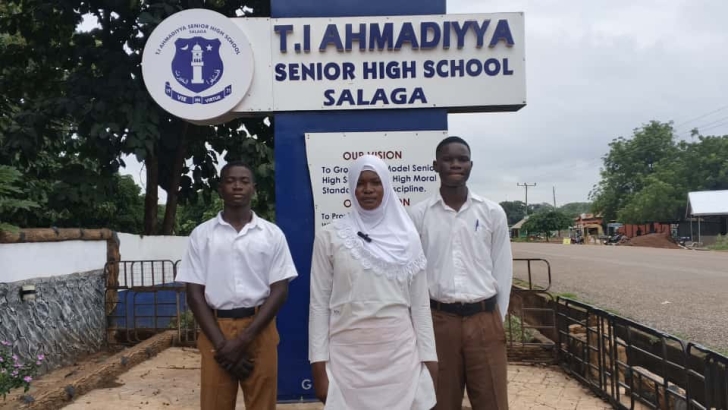
A quiet revolution is taking root in senior high schools across Northern Ghana. For decades, student leadership, particularly the coveted role of head prefect, was a male-dominated sphere.
Today, however, young women are stepping into positions of influence, transforming what leadership looks like both in the classroom and beyond.
From Tamale Senior High School (Tamasco) to Ghana Senior High School (Ghanasco), and most recently, T.I. Ahmadiyya Senior High School (T.I. Amass) in Salaga, female students are not just challenging tradition — they are rewriting it. Their ascent is no accident; it is the result of deliberate policy shifts and changing societal attitudes that prioritise inclusion, equality, and empowerment.
Policy meets progress
At the heart of this transformation is Ghana’s national Gender Equality and Social Inclusion (GESI) policy — a framework adopted by the Ministry of Education and the Ghana Education Service (GES) to promote equity and inclusivity across the education sector. GESI aims to dismantle structural barriers that have long hindered girls, students with disabilities, and other marginalised groups from accessing leadership opportunities.
The policy is part of Ghana’s broader commitment to achieving the Sustainable Development Goals, particularly SDG 4 (quality education for all) and SDG 5 (gender equality). Without such targeted interventions, gaps in school enrolment, retention, and learning outcomes — especially for girls in underserved regions — would likely persist. The integration of inclusive governance models, such as gender-balanced school leadership, is therefore critical in creating educational environments where all learners can thrive.
Breaking a 54-year tradition in Salaga
Perhaps nowhere is this shift more powerfully symbolised than at T.I. Amass in Salaga. There, Miss Atampure Rukaya, an 18-year-old Home Economics student, has made history as the school’s first-ever female head prefect, breaking a 54-year tradition of male-only leadership.
Founded in 1971 by the Ahmadiyya Muslim Mission under the Nusrat Jahan Scheme, T.I. Amass has long stood for academic and moral excellence. But until now, the head prefect position had remained exclusively male. Rukaya’s election, won through a competitive process against two male contenders, marks not only a milestone for the school but also a reflection of broader societal evolution.
Her rise coincides with a landmark national moment: the recent passage of the Affirmative Action Bill by Ghana’s Parliament, further entrenching legal and institutional commitments to women’s representation in leadership.
Leadership by design, not default
According to Mr Issahaku Jahanfo, Headmaster of T.I. Amass, Rukaya’s election was the product of intentional reform, not simply popular vote.
“In 2023, we revised our prefectural selection policy to align with GESI principles as outlined in the Ministry of Education’s School Improvement Plan,” he explained. “Under the new system, the head prefect position is open to any qualified student — regardless of gender.”
With female enrolment now outpacing male enrolment at T.I. Amass (53 per cent to 47 per cent), the change reflects a necessary alignment between leadership and school demographics. “The students defied a 54-year tradition. Their choice sends a clear message — that we are ready to embrace inclusive leadership in line with global standards,” Mr Jahanfo added.
Last year’s most outstanding prefect — the Health Prefect — was also a young woman, laying the groundwork for Rukaya’s trailblazing win.
“A voice for every student”
In her first address as head prefect, Rukaya acknowledged the weight of her new role and the expectations that come with it.
“Leading as a female head prefect will have its challenges,” she said. “But I believe we can overcome them together. I will be a voice for every student — listening to your needs, advocating for your concerns, and fostering a strong sense of community.”
She will be supported by assistant prefects, Master Salifu Yaggu Aliu and Master Dapaah Junior Joseph, forming a gender-balanced leadership team that embodies the values of equity and shared responsibility.
Challenging cultural norms
T.I. Amass’s progress is especially significant given its context as an Islamic mixed school, where traditional gender roles have often constrained female leadership. But those norms are being reshaped.
“Some may argue that in an Islamic mission school, females should not lead,” said Mr Jahanfo. “But we believe — and the Ahmadiyya Mission supports this — that women are not only qualified but fully capable of leading with excellence and integrity.”
The support from both school leadership and the wider community is a powerful affirmation of changing perceptions and growing recognition of women’s capabilities.
A ripple effect across the region
The change at T.I. Amass is not isolated. At Tamasco, Miss Sachibu Zeinab Beininya now serves as First Vice Principal School Prefect, while Miss Sulemana Tungteya Mariam was elected First Assistant School Prefect at Ghanasco. Across the Northern Region, more young women are stepping forward to claim their place in student leadership and winning.
At T.I. Amass alone, seven female students contested top positions this year, with several elected as prefects for Entertainment, Dining Hall, and other key portfolios.
This groundswell of female leadership is more than symbolic. It is a practical shift in the culture of school governance — one that challenges entrenched stereotypes, empowers young women, and signals to communities that their daughters can lead just as effectively as their sons.
Looking ahead: A future of possibilities
The rise of female student leaders in Ghana’s senior high schools mirrors a national movement toward greater gender parity. The election of Ghana’s first female Vice President by President John Dramani Mahama has become a beacon of inspiration for many girls. At T.I. Amass, that inspiration is already fuelling even bigger dreams.
“This is just the beginning,” said Headmaster Jahanfo. “We’ve launched a campaign to raise Ghana’s first female President — and we believe she can come from this school.”
For now, Miss Atampure Rukaya and her peers are paving the way. They are not only breaking barriers in their schools, they are shaping a more just, inclusive, and hopeful future for all.
As Rukaya told her fellow students: “This is not just my victory, but a victory for every girl who dreams of leading — no matter the obstacles.”
