
This week, Africa’s travel trade gathered in Durban in South Africa’s KwaZulu-Natal province to do business, as it does every year around this time.
And for a continent that often struggles to align politics, perception and performance, Africa’s Travel Indaba 2026 delivered a timely reminder – tourism works best when Africa shows up for itself.
In the weeks leading up to Indaba, the mood across the continent was uneasy.
Marches, protests and attacks on foreign nationals in parts of South Africa reignited long-standing anxieties about safety, belonging and pan-African solidarity.
For many across Africa, the concern was not abstract.
Would the continent’s largest tourism trade show feel the strain?
Would buyers stay away?
Would exhibitors quietly scale back?
Indaba arrived – and calmly proved that Africa’s tourism economy is more resilient, pragmatic and interconnected than the headlines and optics suggested.
A measured opening, not a defensive one
At the official opening in Durban, South African President Cyril Ramaphosa set the tone with remarks notable less for rhetoric and more for restraint.
He acknowledged the tensions of recent weeks, condemned xenophobic violence unequivocally and reaffirmed South Africa’s commitment to being an open and welcoming destination.
Crucially, he grounded his message in data and regional reality.
South Africa welcomed 10.5 million international visitors last year, with approximately 75 per cent arriving from within the SADC region.
Tourism, he stressed, is already an African business – powered largely by African travellers.
Ramaphosa reiterated the importance of visa reform, cross-border travel facilitation and shared tourism growth, citing initiatives such as the SADC UNIVISA as central to Africa’s competitiveness in an increasingly fragmented global travel market.
Indaba’s numbers tell their own story
If confidence is measured in participation, Indaba 2026 passed the test convincingly.
According to organisers, South African Tourism, the trade show hosted over 1,100 exhibitors and nearly 1,000 hosted buyers, with appointment diaries full and meeting tables rarely empty.
In 2025, Indaba generated an estimated ZAR246.8 million in direct economic activity and contributed over ZAR610 million to South Africa’s GDP, supporting more than 1,100
jobs. Early indications suggest this year’s edition will match or exceed those benchmarks.
Yet Indaba’s real value lies beyond its economic footprint in Durban.
It remains one of the few platforms where Africa’s tourism trade – public and private – gathers not to theorise integration, but to transact it.
Collaboration in action, not theory
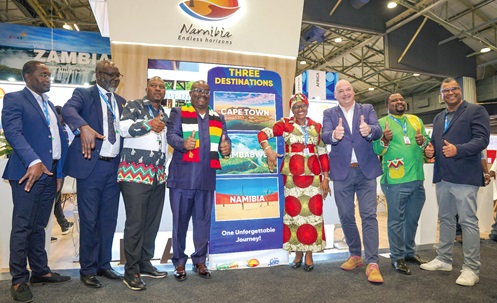
One of the clearest signals of Africa’s evolving tourism mindset came with the launch of a tri-destination partnership between Cape Town, Zimbabwe and Namibia.
Rather than competing in isolation, the destinations announced a joint effort to promote long-haul, multi-country itineraries – encouraging travellers to experience southern Africa as a connected journey rather than a series of disconnected stops.
It is precisely the kind of collaboration Africa has spoken about for years, but too rarely executed at scale.
For buyers and tour operators, the message was unambiguous – Africa is learning to package itself better, smarter and more competitively.
MICE and business travel take centre stage
Another notable shift at Indaba 2026 was the growing prominence of MICE and business travel in policy discussions and programme focus.
South Africa’s Tourism Minister Patricia de Lille highlighted a pipeline of tourism-linked infrastructure investment – from the ZAR24 billion V&A Waterfront expansion to airport developments and new resort projects.
These are not leisure-only assets.
They are designed to attract conferences, incentives, exhibitions and high-value business travellers.
Across panel discussions and side meetings, MICE was framed not as a niche segment, but as a strategic growth lever – one that delivers year-round demand, higher spend and stronger linkages between tourism and trade.
Culture still matters – perhaps more than ever
Despite the business intensity, Indaba retained its cultural soul.
National days, food showcases and informal networking moments reminded delegates why tourism is ultimately about experience.
Zambia’s presence, for instance, blended trade ambition with cultural confidence – inviting delegates to sample its cuisine, music and locally produced beverages while reinforcing tourism’s role in job creation and youth employment.
It was a subtle but powerful reminder that Africa’s strongest tourism proposition is not infrastructure alone, but people.
Choosing delivery over distraction
Indaba 2026 did not pretend that South Africa – or Africa – is without challenges.
But it demonstrated something arguably more important: an ability to separate social turbulence from economic intent.
Buyers came. Exhibitors traded.
Partnerships were announced.
Deals were discussed. Routes were debated.
Strategies were refined.
In doing so, Indaba reaffirmed its place as more than a trade show.
It is a continental checkpoint – a space where Africa takes stock of where it is, argues where necessary, and then moves forward anyway.
Tourism does not thrive in perfect conditions.
It thrives where there is commitment, collaboration and consistency.
This year in Durban, Africa chose all three.
