
Ghana is the first country in Sub-Saharan Africa to gain political independence from British rule.
Ghana has since been a strategic state in the pursuit of its foreign policy with other states worldwide.
Some misjudgements in foreign policy decisions were once made in the past, with some dire consequences for Ghana.
Thus, Ghana’s political leaders might have learned some key lessons.
This piece aims to elucidate the past foreign policy decisions and to highlight the risks of an African state's decision to align entirely with one big power, that is, to depend entirely on one big power for security, defence, among others.
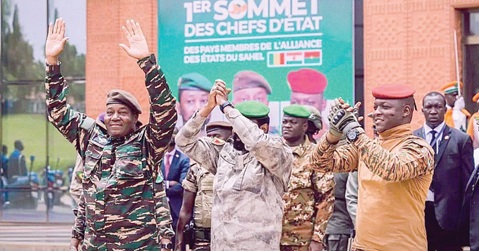
An African state(s) pursuing or taking such a foreign policy decision is seen as a very risky decision, drawing on the case of the Alliance of the Sahel States (AES) aligning entirely with Russia against the West (France, US and their allies).
Strategic partnership- The case of Ghana
A new world order emerged in the 1940s after the Second World War (WW II) with the formation of the United Nations in 1945.
At that time, most countries in Africa were not independent and could not pursue independent foreign policies.
By the 1950s and 1960s, most African states gained their political independence amid the Cold War politics where two superpowers (the United States of America (USA) and the Union of Soviet Socialist Republics (USSR) compete for members (states) on ideological lines.
Ghana and other countries in the Global South saw the risk of aligning to one side of the divide and chose to be non-aligned, leading to the formation of the Non-Aligned Movement (NAM) in 1961.
The NAM became a viable platform for most African states and many other states in the Global South to avoid the risks of aligning with one of the ideological blocs.
Ghana has since pursued the traditional foreign policy of non-alignment.
This foreign policy decision has always been in the best interests of Ghana.
For instance, Ghana’s First President, Dr Kwame Nkrumah, used non-alignment to benefit from both the USA and USSR in securing financial assistance from both sides toward the industrialisation of Ghana, with the construction of bigger projects, including the Akosombo Dam (1961-65), the Tema Motorway (1965), among others.
Such a non-aligned foreign policy orientation made Ghana a friend of both the West (USA and Western allies) and a friend of the East (USSR, China, their allies).
However, toward the late 1960s, President Nkrumah of Ghana was gradually shifting more to the East and avoiding the Western allies (USA and allies).
Such a one-sided alignment was very risky, and that decision, among other internal and external developments, led to the overthrow of President Nkrumah in 1966.
Some political leaders in Ghana took a cue from the misjudgements or the one-sided foreign policy orientation of Nkrumah to continue to be non-aligned for the stability of their regime and the benefits Ghana stands to get when Ghana continues to be non-aligned.
The political history of Ghana has been chaotic with military takeovers (coup d’états) in the 1970s to 1980s.
Ghana returned to multiparty democracy in 1992 and has since remained on that course.
Ghana continues to pursue another core tenet of foreign policy, and that is good neighbourliness.
This policy enables Ghana to maintain friendly relations with her neighbours to the North (Burkina Faso), to the West (Côte d’Ivoire), and to the East (Togo) and the same friendly relations of Ghana are extended to all West African states.
For this reason, Ghana has a concern for the formation of the Alliance of the Sahel States (AES) led by Burkina Faso, Mali and Niger and their exit from ECOWAS. Also, the AES states have taken a bold decision to break away from the West to Russia.
The risk - Case of AES States
There are indeed high risks for a state in the Global South to align solely with one global partner. Experts view the decision by the AES, formed on September 16, 2023, and its dependence on Russia for security, defence and economic fortunes, as a risky decision.
Kipo-Suneyhzi and Lambon (2025) argue that AES states such as Burkina Faso, Mali, and Niger's decision to exit from the regional bloc ECOWAS was not the best.
Also, the AES states’ overdependence on one global power (Russia) may not bring them the best security, defence, political stability, as well as the needed support, especially in the fight against terrorism, insurgency, extremist groups, organised cross-border crimes, and jihadist threats.
Moreover, the Robert Lanshing Institute (2025) reveals more of the risks of the AES states over-reliance or dependence on Russia for security and associated ties with the Russian Private Military Company, Wagner Group or African Corps.
Such relations make AES states more vulnerable to “external demands”, regional isolation, international sanctions/pushbacks, and unlimited access to natural resources, which may lead to natural resource neocolonialism and the syndrome of providing “security for resources”.
Above all, most of their security arrangements or defence cooperation look opaque (very secret).
Recommendation
West African states, including Ghana and other littoral states, risk aligning entirely to one global partner like Russia or a single partner elsewhere.
The best is to push for a “strategic partnership” across the West and the East blocs, toward mutual benefits (win-win game).
West African people/citizens should demand their governments' support for long-term solutions and diversified international partnerships based on accountability.
Above all, no African state should make one global partner an indispensable one for their security/defence.
The writer is an Associate Professor at the Legon Centre for International Affairs and Diplomacy (LECIAD), University of Ghana
