
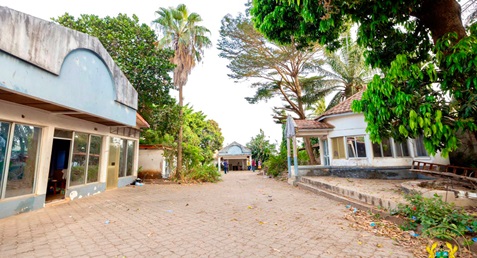
President John Dramani Mahama’s directive to initiate negotiations for acquiring, renovating, and preserving Nkrumah Villa in Conakry stands as a bold and visionary act of historical stewardship.
Announced on January 21, 2026, through the Foreign Affairs Minister, this move seeks to reclaim the residence where Osagyefo Dr Kwame Nkrumah lived and served as Co-President of Guinea from 1966 to 1972.
Far from mere symbolism, it represents a deliberate effort to safeguard a pivotal chapter of Africa’s liberation story, turning a site of exile into a beacon of continental unity and heritage tourism.
In an era when historical narratives risk erosion, this initiative reaffirms Ghana’s leadership in honouring its founding father and the broader Pan-African dream.
The historical weight of Nkrumah Villa
Nkrumah Villa — also known as Villa Syli — served as more than a home during Nkrumah’s exile following the 1966 coup in Ghana.
Granted sanctuary by President Ahmed Sékou Touré, who appointed him honorary Co-President, the seaside residence in Conakry became a hub of intellectual resistance and revolutionary writing.
At the Villa, amid the Atlantic breezes and Guinea’s supportive embrace, Nkrumah authored key works on African socialism, neo-colonialism, and continental unity while plotting the future of a liberated Africa.
The villa witnessed his declining health, his final creative outpourings, and ultimately his departure for medical treatment in Romania, where he passed on April 27, 1972.
For decades, the property has languished in neglect — crumbling facades, overgrown vegetation, and fading echoes of its significance.
His Excellency President Mahama’s intervention addresses this directly, transforming potential loss into purposeful preservation.
Having visited the site on my recent ECOWAS Elections Mission to Guinea in December, 2025, and made some passionate appeals for the need to preserve such a historical monument, my heart glows with joy and elation as President Mahama’s decision stands stoically tall - contributing his quota to keeping the legacy of Osagyefo Dr Kwame Nkrumah solidly alive.
A strategic and symbolic gesture of respect
By directing negotiations with the Sékou Touré family, the Mahama administration demonstrates diplomatic finesse and deep respect for both Nkrumah’s legacy and Guinea’s historical solidarity.
The goal extends beyond ownership: renovation will restore the villa’s structural integrity and convert it into an accessible heritage site.
Visitors — Ghanaian pilgrims, African scholars, international tourists — will trace Nkrumah’s extraordinary journey from Accra’s independence celebrations to Conakry’s exile sanctuary.
This aligns seamlessly with Ghana’s ongoing efforts to honour Nkrumah: the mausoleum in Accra (built by President Rawlings and renovated by President Akufo-Addo), Founder's Day, September 21 (instituted by President Atta-Mills), and Col Kutu Acheampong bringing the embalmed remains of Kwame Nkrumah back to Ghana from Guinea for national interment at Nkroful.
Extending preservation to Conakry completes the narrative arc, offering a “full experience” that links Ghana’s birth as a free nation to Nkrumah’s enduring vision of a united Africa.
It also strengthens bilateral ties with Guinea, fostering cultural diplomacy in West Africa.
Boosting Pan-African Heritage and Tourism
The practical benefits are compelling. A restored Nkrumah Villa could become a cornerstone of heritage tourism, generating revenue while educating global audiences about Africa’s anti-colonial struggles.
Paired with Ghana’s existing Nkrumah sites, it creates a transnational trail for visitors to follow the Osagyefo’s life — from Nkroful birthplace to Accra’s mausoleum to Conakry’s exile home.
In a continent increasingly investing in the cultural economy, this initiative positions Ghana as a steward of shared African memory, inspiring similar efforts elsewhere.
Critically, it counters the risk of historical amnesia. As younger generations engage less with post-independence figures, tangible sites like this villa keep the story alive — reminding us that Nkrumah’s ideals of self-reliance, unity, and justice remain relevant amid contemporary challenges.
Personal resonance and national duty
For those who have walked the villa’s grounds, as this writer did during a “pilgrimage” to Conakry, the site evokes profound emotion.
Standing amid its weathered walls, one feels the weight of sacrifice — the blood and toil of our fathers that secured independence — and renews the solemn pledge: “I pledge myself in all things to uphold and defend the good name of Ghana, so help me God.”
President Mahama’s decision honours that oath on a national scale, ensuring future generations inherit not ruins, but a living testament to resilience.
A legacy that transcends borders
President Mahama’s move is more than policy; it is poetry in action — a recognition that true leadership preserves the past to illuminate the future.
By reclaiming and restoring Nkrumah Villa, Ghana not only pays homage to its only dual-president in history — the man who led Ghana to independence and co-led Guinea in exile — but reaffirms Nkrumah’s immortal truth: Africa must unite.
Indeed, Nkrumah never dies. His spirit, once confined to a modest villa overlooking the Atlantic, now rises renewed through this commendable initiative, calling us all to build the continent he envisioned.
President Mahama is set to become Chairman of the African Union in 2027.
Osagyefo was the brain behind the formation of the Organisation of African Union (OAU), now AU, and if President Mahama is able to complete and commission the project before assuming the Chair of AU, he would be walking on very solid RED CARPET.
Ayekooo!!!
The writer is the Founder & CEO, MILLS Institute for Public Policy Advocacy & Transformational Leadership Development.
Email:
