
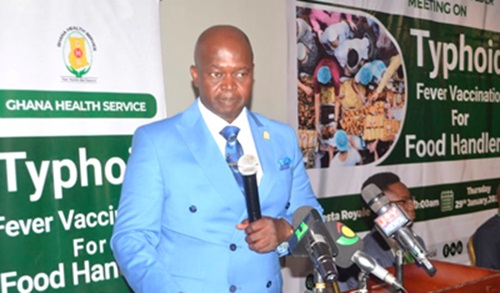
The Ghana Health Service (GHS) has announced plans to roll out a mandatory typhoid vaccination programme for food handlers nationwide.
The initiative will target all workers in the food and drink industry, including street food vendors, market operators, restaurant and hotel attendants, and staff at food and beverage companies.
The vaccine will protect recipients from the disease for three years, serving as a proactive prevention strategy by the GHS to reduce disease transmission among the public.
The rollout is expected to begin in a few weeks after an official launch by the Ministry of Health and the Ghana Health Service.
It will also complement existing medical screening requirements and address persistent gaps in typhoid prevention among food handlers nationwide.
The announcement was made last Thursday by the Director-General of the GHS, Dr Samuel Kaba Akoriyea, at a follow-up stakeholder engagement on the proposed vaccination in Accra.
The meeting was attended by representatives from the Food and Drugs Authority, the Ghana Tourism Authority, metropolitan, municipal and district assemblies, development partners and the food and hospitality industry.
Approach
Dr. Akoriyea said the programme would be implemented in phases, starting with hotels, restaurants and food and beverage companies before extending it to market vendors and other food handlers.
He added that authorities would link vaccination status to the issuance of health certificates required for food industry operations.
He said the vaccine's cost had been subsidised and would be announced after the initiative's launch.
“The vaccines that will be administered are World Health Organisation-qualified and approved by the Food and Drugs Authority, meeting the highest standards of safety, quality and efficacy,” the GHS director-general said.
Dr Akoriyea also emphasised that food handlers played a critical role in daily life and economic activity, but were also a high-risk group for transmitting typhoid fever due to the nature of their work.
“Food handlers occupy a critical position within this public health landscape.
By the nature of their work, they are exposed to contamination and, if infected, can inadvertently contribute to the transmission of typhoid fever,” he stated.
Dr Akoriyea said the initiative was a proactive public health strategy, adding that food handlers who did not receive the vaccination would not be issued the required health certificate to operate.
Collaboration
Dr Akoriyea stressed that the success of the programme depended on strong stakeholder ownership, effective communication and public trust.
He said the programme had emerged from extensive consultations with stakeholders, including the Ministry of Health, regulatory agencies, local government authorities, development partners and representatives of the food and hospitality industry.
He said the process had produced comprehensive implementation guidelines.
He also called on stakeholders to support the rollout and serve as advocates for preventive health interventions, adding that the programme aligns with Ghana’s national health agenda, universal health coverage goals and the Sustainable Development Goals.
The programme would pair vaccination with public education and media engagements.
