
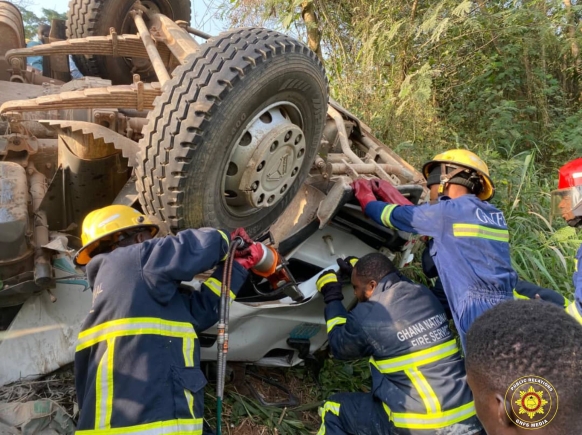
A total of 295 persons lost their lives in road crashes in the Central Region in 2025.
The figure represents an increase of 91 deaths over the 204 recorded in 2024, and accounts for about 10 per cent of the 2,949 national fatalities recorded during the year.
The Central Regional Manager of the National Road Safety Authority (NRSA), Linda Affotey-Annang, who disclosed this, expressed deep concern about the rising trend and cautioned road users, particularly drivers, to strictly adhere to traffic regulations.
“Good roads are not an invitation to speed,” she warned.
Rising fatalities
Ms Affotey-Annang observed that what was most worrying about the 2025 figures was the 44.61 per cent increase in fatalities, describing the year as particularly challenging for both road users and road safety authorities in the region.
“The accident situation remains a serious concern, especially because many of the crashes were severe and largely preventable,” she said.
Regional versus national figures
She explained that out of the 14,743 crashes and 16,714 injuries recorded nationwide, the Central Region accounted for 1,064 crashes and 1,689 injuries, placing the region fourth nationally in both crash incidence and casualty figures.
According to her, although crashes increased marginally by 1.72 per cent from 1,046 in 2024 to 1,064 in 2025, fatalities rose sharply.
She further pointed out that while the number of vehicles involved in crashes slightly reduced from 1,714 to 1,705 in 2025, deaths increased by 91, a trend she described as deeply troubling.
Deadliest crashes
Some of the deadliest crashes recorded in the region in 2025 included one that claimed eight lives at Kormantse in September.
Another accident claimed five lives at Ayensudo in December, while four lost their lives on Christmas Eve at Twifo Ntafrewaso.
Pedestrian knockdowns also rose significantly by 25.21 per cent, increasing from 242 in 2024 to 303 in 2025.
Human behaviour major factor
Ms Affotey-Annang said crash data consistently pointed to speeding, driver distraction, unsafe overtaking and fatigue as leading causes of accidents.
“While the government is investing heavily in road infrastructure through the Big Push, particularly along the Cape Coast–Takoradi corridor, improved roads alone cannot guarantee safety.
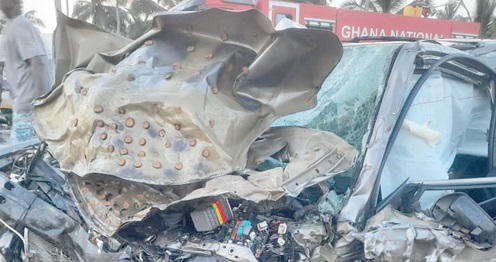
One of the fatal accidents on the Central Region road
Human behaviour remains the most critical factor in crash prevention,” she stressed.
She added that road crashes were increasingly linked to poor attitudes, impatience, risky driving decisions and indiscipline, even on newly improved roads.
“As the government delivers better roads through the Big Push, road users must deliver better behaviour," she added.
Enforcement and accountability
The NRSA, she said, was strengthening enforcement under LI 2468 of 2023, but emphasised that laws alone could not curb the menace without personal responsibility.
"No regulation can replace individual responsibility and safe driving behaviour," she emphasised.
Touching on interventions, Ms Affotey-Annang highlighted the Transport Ghana initiative, a collaboration between the NRSA, Ministry of Transport and private sector partners aimed at improving safety in public transport.
She said the initiative integrated e-ticketing and passenger manifest systems, vehicle tracking and monitoring, electronic payment platforms and a road safety service locator application.
These, she explained, were designed to improve driver accountability, fleet management and regulatory compliance.
Advice to drivers
Ms Affotey-Annang urged drivers to avoid speeding, refrain from dangerous overtaking, rest adequately before long journeys and obey road signs and traffic regulations.
“Arriving late is better than not arriving at all,” she cautioned.
“Crashes are not random events; they are the result of choices.
If we change our choices, we can change the story on our roads,” she added.
