
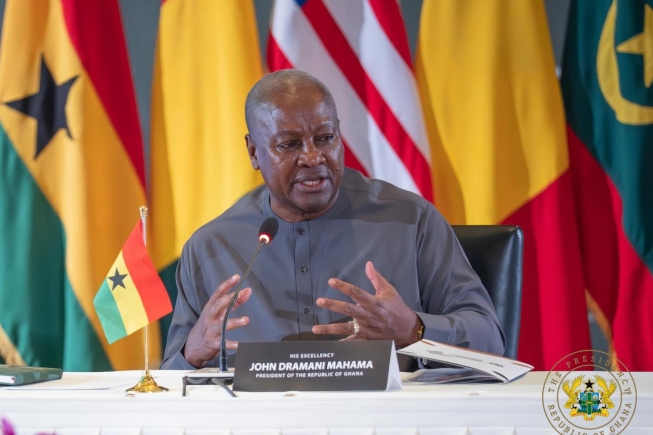
President Mahama calls for collective action on regional security
President John Dramani Mahama has called for collective action to address security, economic and social challenges, which have contributed to making West Africa a viable area for the actions of terrorists and violent extremists.
He stressed that no single country could pursue peace and prosperity; thus, it was important for countries to cooperate for regional stability and prosperity.
Speaking at a high-level consultative conference on Regional Cooperation and Security in Accra last Friday (January 30, 2025), the President emphasised the need for the regional leaders to confront the region’s realities honestly, restore confidence in public institutions, and rebuild inclusive, resilient and forward-looking societies.
He cited the terrorist attack at an airport in Niamey, Niger, last Wednesday (January 28, 2026) as a reminder to the region of the existential threat it faced from terrorists and violent extremists.
He advocated the creation of a new framework for cooperation that would take account of the common threats West Africa faced and, at the same time, respect the sovereignty and political choices of all nations in the sub-region.
The Consultative Conference, which began with meetings of senior officials and ministers, culminated in a summit attended by the President of Liberia, Joseph Nyuma Boakai, and the President of Sierra Leone, Julius Maada Bio.
Interconnectivity, threat
President Mahama underscored the interconnectedness of West African countries, citing shared history, culture and economic ties, adding that threats, including terrorism, extremism and climate change, required a unified response.
“In our region, progress in one country strengthens the collective, while instability or insecurity in another part reverberates across our borders.
It is, therefore, neither realistic nor sustainable for any state to pursue peace, security or prosperity in isolation.
“This reality places upon us a shared responsibility to address our challenges not as isolated national concerns, but as common obligations requiring our collective action and mutual accountability.
Our sub-region is far more than a collection of neighbouring sovereign nations.
“It is a deeply interconnected community shaped by centuries of shared histories, trade, migration and cultural exchange,” he said.
Building trust
President Mahama affirmed that weakened trust, which led to the exit of some states from ECOWAS, had hampered an effective response.
He indicated that violent extremism, terrorism, transnational organised crime, unconstitutional changes of government, youth unemployment and climate-induced vulnerabilities interacted in ways that strained national institutions and tested regional solidarity.
These vulnerabilities, according to him, challenged traditional state-centric responses and demanded a shift towards a more integrated understanding of human security, preventive diplomacy, and collective resilience, principles that were firmly embedded in the ECOWAS security architecture.
He added that without effective coordination and sustained political commitment, even well-intentioned responses would struggle to deliver lasting results.
Unified response
In his address, the Sierra Leonean President and Chairman of ECOWAS, Julius Maada Bio, reaffirmed the need for a unified regional response to terrorism in West Africa, where more than half of terrorism-related deaths occurred.
President Bio stressed that fragmentation was no longer acceptable and that intelligence sharing, logistics, and surveillance were essential to combat the threat.
He also stated that military action alone was insufficient and advocated governance reforms, inclusive development, and economic opportunities to address the root causes of terrorism.
“We must tackle poverty and hunger, strengthen health and education systems, adapt to climate change and expand social protection.
“We must work with the private sector to create jobs and sustainable livelihoods for our citizens in the sub-region.
Governance must be accountable, inclusive and anchored in human rights,” he said.
Commitment
For his part, the Liberian President, Joseph Boakai, affirmed his country's commitment to regional cooperation and security, citing the devastating impact of violent conflicts on Liberia's development.
“I want to state only quickly that Liberia stands by and fully supports this initiative.
Liberia as a nation understands the costs associated with violent conflicts.
“We live in it.
We experienced and continue to bear the scars of the devastating impact.
This is why we are committed to the prevention of conflict of all kinds, nationally, regionally and internationally,” he said.
President Boakai urged leaders to strengthen regional mechanisms, mobilise resources and address socio-economic issues such as youth unemployment and drug abuse.
As a UN Security Council non-permanent member, he said Liberia would continue to advocate a regional approach to peace-building and security, focusing on dismantling terrorist networks and support systems.
