

Establishment of Ghana Gold Board: PMMC engages key stakeholders in Bolgatanga
A day’s regional forum has been held to engage key stakeholders in Bolgatanga in the Upper East Region ahead of the establishment of the Ghana Gold Board.
The event, which brought together chiefs, small-scale miners and civil society organisations among others in the gold value chain, had the objective to introduce the participants to the various sections of the Ghana Board Bill, now passed into law.
Additionally, the forum provided an opportunity for the stakeholders to express their views on what could be done to ensure responsible mining, as well as how mining can be improved to support the Ghana Gold Board to achieve its mandate.
Stabilising the cedi
The acting Managing Director of the Precious Minerals Marketing Company (PMMC), Sammy Gyamfi, indicated that the establishment of the Gold Board would result in the injection of about $250 million into the economy every week to help in the stabilisation of the local currency and make it stronger as well.
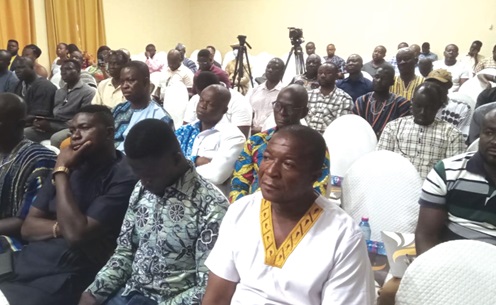
Participants in the event
“If we can buy enough gold every week, the Ghana Gold Board will be able to bring enough dollars to bring down the dollar rate and will enable Ghanaians to have some respite,” he mentioned.
He added that a reduction in the dollar rate would further lead to a reduction in the prices of petrol, diesel and other essential commodities, since they are all imported products.
On support to miners, he said in a bid to shore up gold production, the government would zone and demarcate special areas of concession for small-scale mining, adding “We are committed to supporting you to increase gold production.
Additionally, he indicated that the Gold Board would support small-scale miners with mining equipment and build their capacity, as well as enhance their operations.
Scholarship scheme
Mr. Gyamfi disclosed that students in mining communities would benefit from a scholarship scheme to be introduced by the Ghana Gold Board as part of its corporate social responsibility to enable them to pursue higher education.
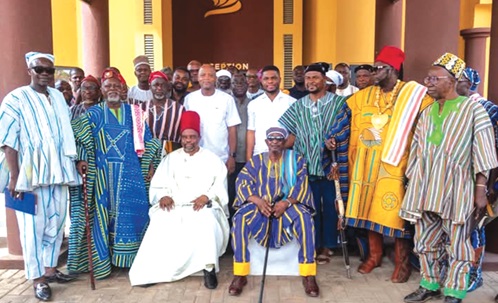
Sammy Gyamfi (middle) with some traditional leaders who were part of the engagement
He said as part of the scheme, the beneficiary children will be supported to pursue further studies in mining-related courses to enable them to come back to work in the companies and to support the general development of their respective communities.
Mr. Gyamfi said some of the students would be given scholarships to pursue further studies in Australia and other advanced countries and that “provision of scholarship to improve education in mining areas will be prioritised”.
He added that the board would also provide boreholes and other water facilities in the mining areas due to pollution of their water sources and stressed that “in these communities, the least we can do is to provide them with water for their daily activities.”
The PMMC boss said that the health of the people would also be prioritised through the provision of health facilities to bring healthcare services closer to the people, as well as the construction of gold roads akin to cocoa roads funded by the Ghana Cocoa Board (COCOBOD).
Strong link
An official of the Bank of Ghana, Paul Bleboo, in a remark, said there was a strong link between gold and currency stabilisation and added that an amount of $4 billion was used to buy gold last year, which was used to shore up the country’s forex.
He underscored the importance of setting up the Ghana Gold Board as it would streamline, especially gold pricing, at the downstream.
A Gold Trading Consultant, Roger Kwakye, said according to a United Nations report, although $1.5 billion was exported in 2022, only $900 million was recorded in Ghana.
In 2023, $900 million was also exported out of the country, but only $300 million was recorded.
He added that the coming into force of the Ghana Gold Board would deal with the losses of gold export, thereby fixing the nation’s foreign exchange needs.
The Paramount Chief of the Bongo Traditional Area, Naba Baba Salifu Atamale Lemyaarum, applauded the government for the decision to introduce cooperative mining as it would address unemployment in the mining areas.
Writer’s email:
