
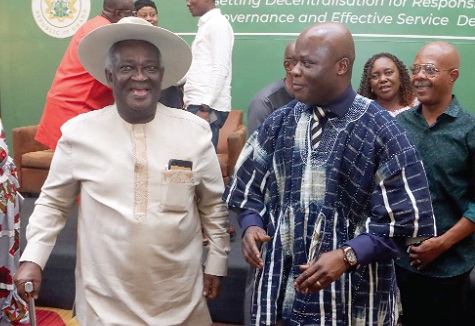
Give entire DACF to MMDAs — Prof. Ahwoi
The District Assembly Common Fund (DACF) constitutionally belongs to the metropolitan, municipal and district assemblies (MMDAs), so they must have all of that money, a local governance expert, Prof. Kwamena Ahwoi, has stated.
He stressed that all bodies that were currently benefiting from the DACF, apart from the MMDAs, must be chipped off as a matter of urgency.
"If they are not immediately cut off, the constitutionality of their continuous benefit from the fund must be tested in the Supreme Court," he stressed.
The renowned politician, who is Ghana's longest-serving Local Government Minister, made the call on the second day of the national dialogue on decentralisation and responsive governance in Accra last Friday.
Held on "Resetting decentralisation for responsive local governance and effective service delivery", the dialogue brought together experts in the local governance space, including policy makers, academia, civil society and development partners.
Prof. Ahwoi spoke on the topic: "Using the past to inform the future: resetting decentralisation for responsive local governance and effective service delivery: political, administrative and economic development imperatives".
Economic development
His presentation touched on decentralisation from the political, administrative, and economic development imperatives, stressing the need for the current constitutional review process to provide reforms to bolster those aspects of local governance.
The local government expert emphasised that proactive steps must be taken to capacitate the MMDAs to collect the income tax from economic operators in the informal sector as stipulated in the Local Government Act.
Additionally, he underscored the need to expand the internally generated fund (IGF) base of the MMDAs to stop the over-reliance on funds allocated from the central government.
He added that if the government's agenda to reset the local governance system would succeed, efforts must be made to put MMDAs at the centre of shaping economic activities in their jurisdiction.
Diligence
The Minister of Local Government, Chieftaincy and Religious Affairs, Ahmed Ibrahim, said it was in a bid to make the MMDAs robust to deliver on their mandate that the President caused over 80 per cent of the DACF to be disbursed to the assemblies.
He urged the chief executives of the assemblies to ensure that the guidelines for the utilisation of the funds were strictly adhered to, especially in the execution of priority projects and completion of legacy projects started by the previous government.
“The guideline clearly states that the MMDAs should use 20 per cent of the DACF disbursed to them every quarter to work on the uncompleted projects until they are all completed,” he said.
Mr Ahmed also urged the MMDAs to channel most of their IGF into key technical capacity building to boost service delivery.
Ethical leadership
The Founder and President of the Institute for Security, Disaster and Emergency Studies, Ghana, Dr Ishmael Norman, said the reset of the decentralisation system would require ethical leadership that would champion transparency and accountability in service delivery.
Furthermore, he said, persons at the helm of affairs at the MMDAs must be servant leaders who have the capacity to deliver policies that resonate with the needs of the people.
"To be a good leader, you need to observe your ecosystem, the people around you, and morality should be the conscience of your leadership," he said.
Dr Norman further stated that the reset of the local governance system must be anchored on establishing a robust structure for meritocracy.
He said MMDAs must also put in place structures to strengthen disaster risk management systems to deliver efficient humanitarian services in times of disasters.
"The country is under-prepared for an emergency, and this needs a total reset if the decentralisation system is to work well," he added.
