
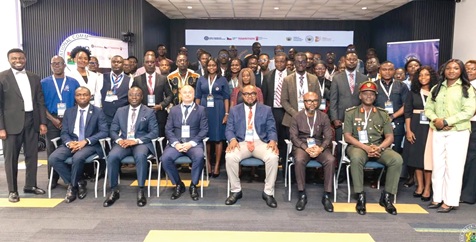
The Cyber Security Authority (CSA) has called on journalists and media practitioners to intensify public education on cybersecurity to help protect citizens from cybercrime, online fraud and digital extremism.
The Director-General of the CSA, Divine Selase Agbeti, who made the appeal, explained that informed reporting was one of the country’s strongest weapons against emerging digital threats who thrived by exploiting unsuspecting individuals in society.
“The media does far more than reporting incidents. You prevent them. A single radio discussion in a local language can prevent thousands of people from becoming victims of fraud.
A television interview can expose a news scam before it spreads nationwide. Accurate and responsible reporting can protect lives, businesses, and even national security,” he said.
He was speaking at the launch of the National Community Media Cyber Capacity Building Project (NCMCCBP) held in Accra on Monday.
The initiative, which is a partnership between the CSA, the Africa Centre for Digital Transformation (ACDT) and the Government of the Czech Republic, seeks to strengthen journalists’ capacity to report accurately on cybersecurity, while establishing a Cyber Security Press Corps to deepen public awareness and support the country’s national cyber resilience agenda.
Mr Agbeti said cybercriminals and extremist groups were increasingly exploiting digital platforms to spread propaganda, recruit followers, raise funds and manipulate public opinion, making responsible journalism more critical than ever.
He said the Authority, working with the Ghana Police Service, National Security, EOCO and international partners, had intensified operations against cybercrime, stressing that “cybercrime is organised crime” requiring coordinated action.
Bedrock of innovation
Representing the Minister of Communication, Digital Technology and Innovations, the Deputy Minister, Mohammed Adams Sukparu, described cybersecurity as the bedrock of the country’s digital transformation agenda, stressing that trust remained the currency of every successful digital economy.
He said the government was pursuing an ambitious programme anchored on digital infrastructure, artificial intelligence, innovation, regulatory reforms and digital skills development, including the One Million Coders Programme and the National Artificial Intelligence Strategy.
However, he said these investments could only yield results within a secure digital environment. He noted that the community media project recognised that technology alone could not defeat cyber threats, emphasising that informed citizens remained the country’s strongest defence.
Partnership
The Ambassador of the Czech Republic to Ghana, Pavel Bílek, said the project reflected the growing strategic partnership between Ghana and Czechia in cybersecurity over the past four years.
He said the Czech Government had supported the country through expert training, modern forensic equipment and institutional partnerships, adding that strengthening media capacity would complement law enforcement efforts by equipping journalists to educate citizens on cyber risks and promote responsible public communication.
An Advisory Board Member of the ACDT, Emmanuel Agyare, said the project sought to strengthen the technical, ethical and operational capacity of community media practitioners to report effectively on cybercrime, digital threats and national cybersecurity issues.
He said the initiative would enhance public awareness through local language broadcasting, deepen collaboration between the media, the CSA, national security and other law enforcement agencies, and establish a Cyber Security Press Corps made up of trained journalists across the country.
