
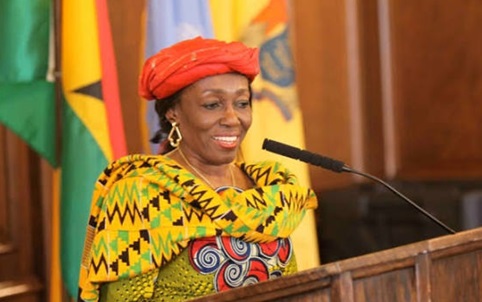
Nana Konadu: A symbol of women empowerment
In Ghana’s political and cultural history, few images are as striking as that of Nana Konadu Agyeman-Rawlings.
Poised, confident and crowned with her trademark red beret.
It was more than an accessory, and became a symbol of revolutionary spirit, resilience and reform, a visual echo of an era that reshaped Ghana’s political landscape.
As the wife of Flt Lt Jerry John Rawlings and the now deceased hero of the June 4, 1979, and December 31, 1981, military interventions, Nana Konadu stood at the crossroads of politics and activism.
Through the 31st December Women’s Movement, she championed women’s empowerment, community development and economic inclusion at a time when female voices were often marginalised.
Her red beret, bold and unapologetic, embodied her courage to challenge societal norms and demand equality.
Memories
For many, the beret evokes memories of Ghana’s revolutionary 1980s, when red symbolised vigilance and sacrifice.
Yet, for Nana Konadu, it transcended politics to represent personal conviction and leadership.
Even as she transitioned into partisan politics, founding the National Democratic Party (NDP) at the twilight of public life, the red beret remained her enduring emblem, a statement of identity and defiance.
Legacy
Today, the image of Nana Konadu in her red beret endures as more than a fashion signature.
It is a legacy of strength, a reminder of how one woman wove activism, style and power into a single fabric of national consciousness, forever marking her place in Ghana’s political history.
Through it all, she reminds generations of Ghanaians that leadership, like revolution, begins with courage.
Throughout her public life, Nana Konadu Agyeman-Rawlings was a formidable advocate for gender equality and social justice.
Under her leadership, the 31st December Women’s Movement established over 870 pre-schools, promoted adult literacy, family planning, child development and women’s participation in governance.
Her efforts were instrumental in Ghana becoming the first country to ratify the UN Convention on the Rights of the Child in 1991.
She also championed the Intestate Succession Law (PNDCL 111), a landmark legislation that secured inheritance rights for widows, reshaping Ghana’s customary laws on marriage and property.
Through tireless grassroots mobilisation, she inspired women across the country to engage in politics and civic life, leading to a marked increase in female representation in Parliament in the early 1990s.
Women empowerment
Nana Konadu Agyeman-Rawlings is considered one of Ghana’s most influential women, often described as a visionary leader, a reformer and a symbol of courage in the struggle for gender equality and national development.
Her life’s work transformed the discourse on women’s empowerment in Ghana and across Africa, and her voice remained a force for progress long after she left office as First Lady.
She was, for a long time, the President of the 31st December Women’s Movement, which later metamorphosed into DWM.
NDP
In October 2012, Nana Konadu Agyeman-Rawlings founded the National Democratic Party (NDP) to pursue her political project.
Prior to charting this path, Nana Konadu was a founder member of the governing National Democratic Congress (NDC), the party of her husband, before breaking away after her hope of clinching the party’s presidential candidate nomination ticket failed in 2011.
It held its first national congress at the Baba Yara Stadium in Kumasi on October 13, 2012, endorsing Nana Konadu as its leader.
The October 13, 2012, congress named Dr Josiah Aryeh as the National Chairman of the party.
Nana Konadu took part in the 2016 and 2020 presidential elections.
The NDP’s General Secretary, Alhaji Mohammed Frimpong, however, stood on the ticket of the party for the 2024 presidential election.
