
Rice sector can swell by 2,600%: Unlock growth with strategic investments - IFS study
The country has the potential to increase rice production to 35 million tonnes annually and become a major exporter of the staple crop.
However, going past the current rice production of 1.28 million tonnes requires government-led strategic investments in land development, irrigation, mechanisation, seed quality and fertiliser production.
An economic think tank, Institute for Fiscal Studies (IFS), which made the projection in its new study, explained that the 1.28 million tonnes of paddy rice the nation produced in 2022 could increase by over 2,600 per cent if the nation properly utilised its vast agricultural potential and implemented the right policies.
The report of the study titled: “Increasing Importation of Rice in Ghana: Can the Country Transform its Fortunes in the Rice Sector?”, was presented at an event in Accra yesterday.
The acting Executive Director and Senior Research Fellow, Dr Said Boakye, who presented the findings, said, “If Ghana achieves an average rice yield of six tonnes per hectare like Vietnam, and fully exploits its 5.9 million hectares of suitable land for rice farming, the country can produce 35.4 million tonnes of paddy rice annually”.
Comparing the outcome of the study to Thailand and Vietnam, two of the world’s top three rice producers, he explained that such an output would not only make the country self-sufficient but could also turn it into a major net exporter capable of earning billions of dollars from rice exports.
“Given our current consumption levels, Ghana would not even need to produce this entire volume before becoming an exporter. Producing just 7.4 million tonnes of milled rice could have yielded exportable surpluses worth about $3.2 billion in 2022,” Dr Boakye said, stressing that the country’s persistent importation of rice was a policy failure rather than a natural limitation.
“Ghana has all it takes — the land, labour and technical knowledge — to achieve rice self-sufficiency and even dominate regional exports. What is missing is the political will and strategic investment,” Dr Boakye emphasised.
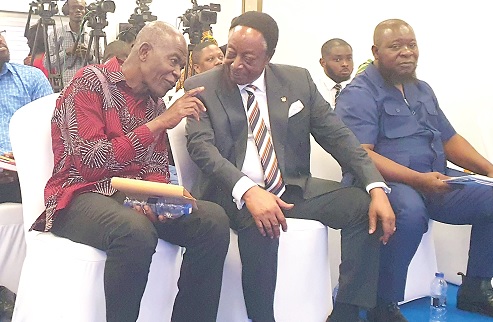
The event brought together representatives of agriculture related state institutions, researchers, farmers, traders, agribusiness investors, development partners, among others.
Rice development board
The IFS study recommended the establishment of a National Rice Development Board to spearhead a coordinated national effort towards transforming the sector.
The proposed board, it said, should serve as the central body for planning, financing and implementing all government interventions in the rice value chain — from production and harvesting to storage and marketing.
Dr Boakye said the board should be equipped both technically and financially to address critical constraints that had long hindered Ghana’s rice potential, including low fertiliser use, inadequate irrigation infrastructure, poor seed systems, weak mechanisation and limited access to farmland.
“The government’s over-reliance on the private sector has led to huge market failures. We need strong state involvement just as Vietnam and Thailand have done.
“A rice development board will institutionalise this role, prevent policy discontinuity and depoliticise interventions,” he explained.
Domestic production
The IFS urged the government to secure and allocate more land for rice farming by acquiring large tracts of suitable land and redistributing them fairly to farmers and youth groups through affordable leases.
Ghana, the study emphasised, had over 5.9 million hectares of land suitable for rice cultivation — four million hectares of lowlands and 1.9 million hectares of irrigable land — yet only 0.3 to 2.6 per cent of the total agricultural land is currently used for rice.
Additionally, the report called for massive expansion in irrigation, pointing out that only five per cent of the county’s arable land was irrigated, compared with nearly 66 per cent in Vietnam.
“The Rice Development Board with adequate financing should work with the Ghana Irrigation Development Authority to develop adequate irrigation facilities on the estimated 1.9 million hectares of land identified to be suitable for irrigated rice farming,” Dr Boakye said.
Fertiliser, irrigation
He further advocated the local production of fertiliser and certified seeds, arguing that the country’s dependence on imported fertiliser and low use of certified rice seeds — currently less than five per cent — continued to undermine productivity.
“Over 70 per cent of fertiliser currently used in Vietnam is produced domestically by mostly state-owned enterprises using subsidised input. This makes fertiliser readily available to rice farmers and at comparatively low prices.
“As of 2021, for instance, there were more than 800 chemical fertiliser plants in Vietnam, which produce 7.92 million tonnes of fertiliser,” he said, adding that Ghana could replicate the success through targeted state investment and partnership.
Youth mobilisation, mechanisation
As part of the strategy to expand production, IFS proposed the mobilisation of young people into large-scale rice farming through credit support and the creation of team-based ventures insulated from political influence.
It also recommended incentives for local manufacture of farm machinery in partnership with firms such as Kantanka Automobile to promote mechanisation.
“The Rice Development Board should not only support land preparation but mechanise the entire farming process.
Locally designed and affordable machinery suited to Ghana’s terrain can significantly cut costs and boost yields,” the study advised.
