
Traditional leaders, MMDAs to partner for development — President
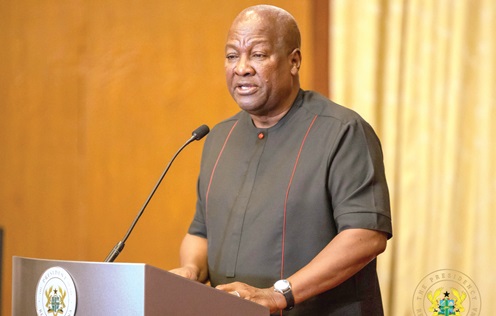
President John Dramani Mahama has said that the government is to create a framework that will allow traditional rulers to partner with district assemblies to monitor development projects.
Such a partnership would mark a significant shift from occasional consultations to structured collaboration for accelerated development at the grassroot.
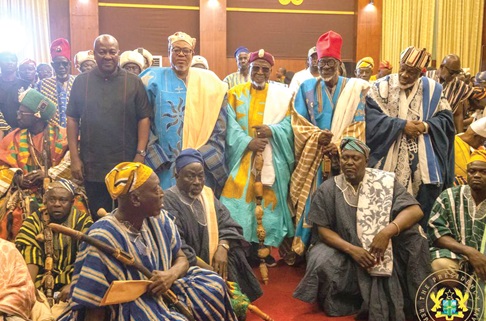
The President was speaking yesterday during a courtesy call on him by members of the Northern Regional House of Chiefs at the Jubilee House in Accra.
The delegation was led by the Naa Andani Dasana Abdulai II, and included Paramount Chiefs in the Northern Region.
Present was the Chief of Staff, Julius Debrah; the Minister of Education, Haruna Iddrisu; Deputy Minister for Local Government, Chieftaincy, and Religious Affairs, Rita Naa Odoley Sowah, and other government officials.
Influence
President Mahama acknowledged that for far too long, governments across Africa had underutilised the influence of traditional leadership, despite chiefs remaining the closest to the people, commanding diplomacy rooted in history, culture and trust.
“Your proposition that the government must move from occasional consultations with you to an extended partnership is both timely and industrious, and I fully agree with you.
“One of the greatest frustrations of our people is the gap between projects that are announced and projects that are completed – between funds that are allocated and finally delivered. Chiefs as community leaders can become active partners in monitoring mechanisms,” he said.
President Mahama, therefore, directed the Minister of Local Government, Chieftaincy and Religious Affairs to create a mechanism where traditional rulers and district assemblies would meet periodically to review progress on critical infrastructure projects, including joint physical inspection of sites.
Assurance
The President assured the chiefs that the Northern Region remained central to the government’s transformation agenda, describing it as strategically positioned to become a major agricultural production hub under the 24-hour economy initiative and a revised Export Development Programme.
He said that the government was creating space for investment under a policy coordinated instruments of the IMF after a successful exit of the Extended Credit Facility, with agriculture being identified as a key sector to invest in.
“The Northern Region has vast arable lands for large-scale agriculture and, therefore, will be one of the main beneficiaries of the initiative, which will include agro-processing,” the President said.
Peace and infrastructure
On the long-standing Bawku conflict, President Mahama reaffirmed the government’s commitment to work with the National and Regional Houses of Chiefs, security agencies, and all stakeholders to ensure that lawful processes and tradition were respected.
“Peace is the foundational infrastructure of development. Without peace, roads, schools, hospitals and investments cannot flourish,” he said.
On drug abuse among the youth, President Mahama entreated the traditional leaders to work with youth groups and the police to identify distributors of narcotics within their respective traditional areas.
He also said that the government was prioritising the completion of a psychiatric hospital for the five northern regions since there was currently no such facility in the entire area.
On peace, the President commended the chiefs for their commitment to peace building, citing the declaration of peace in Bawku as a powerful example of what could be achieved when traditional authorities, the state and communities worked together in good faith.
Chieftaincy disputes
Naa Andani Dasana Abdulai II drew the President’s attention to the protracted chieftaincy dispute in the Nanung Traditional Area, which had festered over the years, resulting in periodic violence, loss of life, destruction of property, displacement of people, and stalled development.
“Your Excellency, the 1992 Constitution, the Chieftaincy Act 2008 (Act 759), and the Alternative Dispute Resolution Act 2010 (Act 798), all outline procedures for resolving chieftaincy disputes in the country.
“The Bimbila chieftaincy dispute went through the structures and various levels of arbitration and was settled.
However, there is still limited law and order, even after the Supreme Court’s ruling on the matter,” the said.
Naa Dasana Abdulai II, therefore, appealed to the President to ensure the implementation of the rulings of the Regional and National Houses of Chiefs and the Supreme Court.
