
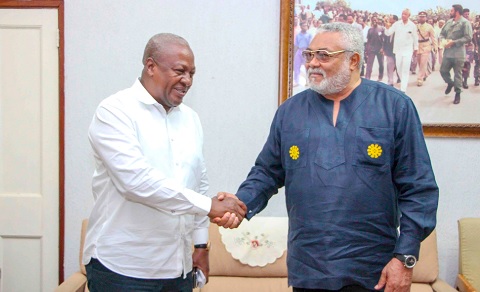
Jerry John Rawlings: What is the legacy?
According to the former University of Ghana Vice Chancellor, Professor Ernest Aryeetey, ‘Rawlings came with anger — and that anger drove most of what he did’.
Prof. Aryeetey is referring to Flt. Lt. Jerry John Rawlings’s explosive entry into Ghana’s politics more than 40 years ago.
On May 15, 1979, Rawlings led an unsuccessful coup attempt, was incarcerated, released by military allies and headed another – this time successful coup – briefly to take power before handing over to a democratically elected government later the same year.
Productive anger
Prof. Aryeetey is right: Flt. Lt. Rawlings was motivated by anger. But, contrary to what Prof. Aryeetey implies, it was productive and righteous anger.
He was angry because of the gross corruption, mismanagement and self-serving behaviour of the then power holders, senior military personnel.
He was incensed when senior military figures, people he respected and regarded as his superiors, let themselves and the country down by their flagrant mismanagement and egregious corruption.
By the late 1970s, Ghana was broken, defeated and in despair: something had to change.
I first visited Ghana in 1985 to research a PhD about Jerry John Rawlings’s leadership of the Provisional National Defence Council (PNDC) regime, a revolutionary government that sought to address Ghana’s myriad economic, political and social ills.
Today, 40 years later, and five years after Jerry John Rawlings’s sudden death in November 2020, Prof. Aryeetey reignites the debate about his achievements and legacy.
My own thoughts on the matter are captured in my book-length analysis of politics in Ghana from the mid-1970s to the mid-2020s: Revolution and Democracy in Ghana: The Politics of Jerry Rawlings (Digibooks Ghana Ltd, 2024).
The Majority Chief Whip, Rockson-Nelson Etse Kwami Dafeamekpor, NDC MP for South Dayi, hit back against Prof. Aryeetey in a message on his social media accounts on October 22.
Mr Dafeamekpor claims that ‘certain academics’ are ‘obsessed’ with attempts to diminish the influence and legacy of Jerry John Rawlings, both at home and abroad.
Returning to Ghana in 2022 after a lengthy absence, and regularly visiting the country since then, I am struck by the antipathy directed against Mr Rawlings, including by some ‘academics’. On the other hand, he has many admirers too.
Global service
Mr Rawlings served in high-profile roles outside Ghana following his stint as president. For example, in November 2000, he was named as the first International Year of Volunteers 2001 Eminent Person by the then-United Nations Secretary-General, Kofi Annan. In this capacity, Mr Rawlings attended various events and conferences to promote volunteerism.
In October 2010, he was named the African Union envoy to Somalia, and a month later, he attended the inauguration of Desiré Delano ‘Dési’ Bouterse as president of Suriname.
He delivered lectures at universities, including the University of Oxford in the UK. In July 2019, he made a three-day working trip to Burkina Faso, as Chairman of the Thomas Sankara Memorial Committee.
Finally, in September 2019, he paid tribute on behalf of the president and people of Ghana, leading a delegation to the funeral of the late former president of Zimbabwe, Robert Mugabe.
In sum, Jerry John Rawlings was an eminent global figure following his retirement from front-line politics in Ghana.
Gratitude
Ghanaians have Jerry John Rawlings to thank for the almost 33 years of democracy that the country has enjoyed since the inauguration of the Fourth Republic in January 1993.
Some presidents in Africa are very loath to step down from power, doing all they can to maintain their grip on the top seat – by various means, both fair and foul.
Mr Rawlings voluntarily stepped down from power according to the democratic will of the Ghanaian people, not perhaps without regret but sure in the knowledge that he had done the best he could for the country.
This was not an inchoate and destructive ‘anger’: it was a patriotic duty which he gladly accepted.
How then should Jerry John Rawlings, politician and national leader, be perceived by Ghanaians, including by young people who were not born during the sometimes-tempestuous years of his political dominance?
I am, sometimes, accused of being ‘pro-Rawlings’ and I indeed came to Ghana in 1985 as a doctoral student who was – from afar – impressed and intrigued by Ghana’s revolution.
Spending months in the country and interviewing dozens of people, both from within the PNDC regime and outside it, it became clear to me that the revolution was problematic and that those in charge, including Mr Rawlings, made many mistakes.
Some would aver that such missteps – including in relation to human rights violations – were unforgivable and that many Ghanaians suffered during PNDC rule. I interviewed many such people in London in the late 1980s.
Desire to change
Both Prof. Aryeetey and Mr Dafeamekpor have got it right. Although Jerry John Rawlings was ‘angry’, it was anger motivated by a desire to change Ghana for the better. Mr Dafeamekpor lists achievements of Mr Rawlings and the PNDC, including an unswerving focus and commitment to national development, expansion of rural electrification from 40 per cent to 71 per cent, introduction of local government elections in 1987 and ‘full’ democracy in 1993, and rehabilitation of the Dr Kwame Nkrumah Museum through the establishment of his mausoleum in Accra.
Mr Rawlings remains a controversial figure.
But the time is ripe for a candid yet objective assessment of the most important Ghanaian since Dr Kwame Nkrumah.
The writer is Emeritus Professor of Politics at the London Metropolitan University, UK.
