
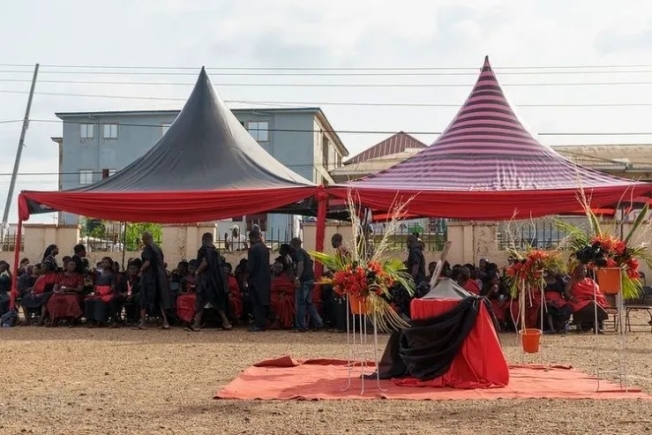
There’s a popular saying in Ghana that “we love the dead more than the living.
” It sounds like a joke until you realise it’s painfully true.
By the time you cross your teenage years, this bizarre reality starts to shape your life, whether you’re in school, church, the corporate world, or even in how insurance and banking products are sold to you.
In Ghana, funerals are not just solemn events to bid farewell to loved ones; they are public spectacles, expressions of love, power, and social standing.
And over time, welfare, whether in the family, the workplace, or the church, has become synonymous with death benefits.
Funeral economy
Scholars have written volumes about Ghana’s booming funeral industry.
While it’s deeply rooted in cultural traditions that honour the dead, it has evolved into a competition, a contest of who can organise the grandest funeral.
Insurance companies have seen the opportunity and turned it into a goldmine.
Funeral policies are now the poster child of insurance marketing.
The first thing an insurance salesperson offers you is not health coverage or investment options, it’s a “funeral plan.”
Their pitch is simple: “When you die, your family won’t struggle.”
And so, even in life, death becomes our biggest investment.
Every Ghanaian family has that one uncle, the self-appointed “chief whip” of the clan.
As soon as a relative dies, he starts sending messages: “We have to contribute!” And of course, everyone must pay up, no excuses.
Suggest something different, like using family funds to pay school fees for needy children, and you’ll quickly become the black sheep.
Selling family land to educate the next generation is often frowned upon, but selling it to fund a funeral? Perfectly acceptable.
Some families even take loans or sell valuable property just to host elaborate funerals.
Today, funeral billboards dominate our streets; radio, television, and social media buzz with funeral announcements.
It has become a culture of spectacle, an economy that thrives on mourning.
Employers and the paradox of welfare
Walk into any Ghanaian company and ask about their employee welfare policy.
You’ll probably find generous death benefits listed for parents, spouses, or children.
Employers take pride in “supporting” staff during bereavement, sometimes offering tens of thousands of cedis.
But scratch a little deeper, and the paradox becomes clear.
These same organisations that pay generously when you die rarely offer scholarships for your children or maternity support for mothers.
One friend of mine once remarked, “My company will pay more when my father dies than when my wife gives birth.”
That irony says it all; we have institutionalised grief and ignored the living.
Church welfare systems, too, are heavily funeral-centred.
The welfare chairman’s main job often revolves around bereavement, coordinating visits, organising donations, and ensuring the church is well represented at funerals.
If a welfare chairman fails to show up at a member’s funeral, it’s almost a scandal.
But how many churches have structured welfare programmes for unemployed members, single mothers, or struggling students? In most congregations, death receives more attention and better funding than life itself.
Social media and the digital funeral club
Social media was supposed to connect us and make life easier. Instead, it has given birth to a new digital culture of funeral contributions.
We all belong to WhatsApp groups, old schoolmates, church members, office colleagues and family groups.
And increasingly, these have become mini-funeral societies.
The moment someone posts, “We’ve lost our brother,” the group suddenly springs to life. Contributions flow swiftly, like soldiers obeying a command.
But try suggesting that the same group raise funds for a business startup, pay someone’s hospital bill, or sponsor a child’s education, and you’ll meet silence, delays, or excuses.
It’s as if we are more united in mourning than in living.
Some of these groups have even gone a step further, buying group funeral insurance policies to “prepare for the inevitable.”
This deep-rooted communal love for funerals could be a powerful force for good if only we redirected it.
Imagine if the same passion we channel into organising funerals was invested in supporting education, health care, or entrepreneurship.
There are people in these same groups who can’t feed their families, can’t afford medication, or have dropped out of school.
Yet, when a funeral arises, we rally, contribute, and show up in full force.
Who gets an A-star for organising the best funeral in town? No one.
But we could all earn one if we shifted our energy from the grave to the cradle, from mourning the dead to supporting the living.
It’s time to rethink our definition of welfare.
True welfare is not how well we bury the dead, but how meaningfully we support the living.
Author’s email:
