
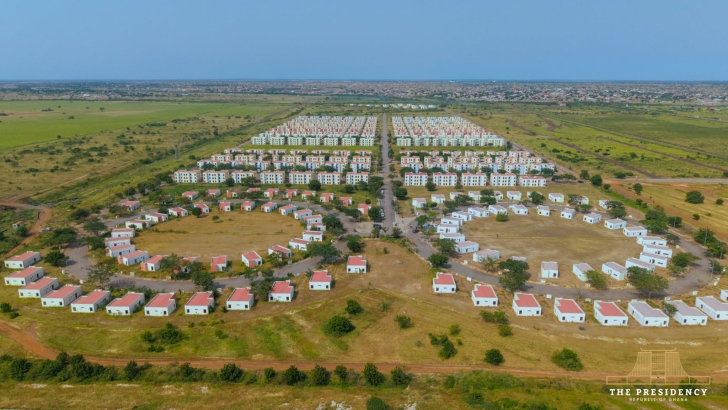
Ghana's poor urban planning is choking the real estate industry
Why Ghana must build communities, not merely approving buildings
Real estate development does not take place in isolation. A developer may construct a beautiful house with high-quality materials and every modern convenience, but the value and marketability of that property will ultimately be affected by the condition of the community in which it is located.
Good roads, proper drainage, potable water, sanitation, security, street lighting, open spaces and effective zoning are not luxuries. They are essential components of every successful residential development. Ghana's failure to plan and manage its rapidly growing cities is making property development more expensive, reducing the attractiveness of many communities and discouraging homebuyers from paying the prices required to sustain quality construction.
In 2026, Ghana is still struggling to distinguish properly planned residential areas from commercial and industrial zones. Shops, drinking spots, churches, schools, mechanic workshops and event centers operate indiscriminately within residential communities. Pavements and road reservations are occupied by traders and temporary structures. Buildings are constructed without adequate parking, while some developments block waterways or encroach on land reserved for roads and public facilities.
This disorder is not happening because Ghana has no planning laws. The country has the Land Use and Spatial Planning Act, 2016 (Act 925), the Local Governance Act, 2016 (Act 936), and several national and local development frameworks. The real problem is weak implementation, poor coordination and the failure of the responsible institutions to enforce existing standards consistently.
It is also worth acknowledging that developers are not without fault. Some cut corners on build quality, engage in speculative land-banking, or price properties in ways that owe as much to opportunism as to genuine cost pressures. This piece focuses on the planning and infrastructure failures upstream of the industry, but that should not be mistaken for a claim that developers bear no responsibility at all.
Developers are paying for government's planning failures
When a developer buys land in a poorly serviced area, the cost of providing a house goes far beyond cement, iron rods, blocks, roofing, tiles and labour. The developer may have to construct or improve the access road, drill a borehole, install water-storage tanks, provide private drainage, build septic systems and sometimes extend electricity to the site, services that should ordinarily be coordinated by the state before large-scale development is permitted.
The homebuyer, however, may not understand why a house in a poorly developed community should attract a high price. The buyer sees bad roads, open gutters, stagnant water, uncollected waste and commercial activities operating without control. No matter how attractive the house may be, the surrounding environment reduces its perceived value.
This creates a serious problem for the real estate industry. The developer calculates the selling price based on land, materials, labour, financing, taxes, permits and a reasonable return on investment, while the buyer calculates value based on the neighbourhood as much as the building. When the two cannot be reconciled, a house may remain on the market for a long time, not because it is overpriced, but because the surrounding infrastructure does not support its price.
Bad roads reduce property values
Roads are among the most important factors that influence the attractiveness of a residential community. A property may be only a few kilometers from a major commercial center, but if the access road is in poor condition, that short distance becomes a major inconvenience, increasing travel time, damaging vehicles, and making it difficult for emergency services, refuse trucks and water tankers to reach communities.
Developers are sometimes compelled to use their own resources to grade roads merely to allow building materials to reach their sites, and transport operators consequently increase their charges, another hidden cost passed into the final price of the house. A family purchasing a home does not want to spend millions of cedis on a property only to struggle to enter or leave the community whenever it rains.
Drainage and sanitation cannot be aferthoughts
Ghana's approach to drainage has largely been reactive. We often wait for communities to become heavily built-up before attempting to construct drains. By then, land that should have been reserved for drainage has already been sold or encroached upon, and buildings may already be sitting in waterways, making compensation or demolition politically and financially difficult. Approving buildings without a comprehensive drainage plan only transfers the consequences to future residents.
Poor sanitation creates a similar problem. Waste is dumped in drains, on undeveloped plots and along roads because many communities lack an organised waste-management system, and this makes it extremely difficult to market even a luxury property when the road leading to it is surrounded by open refuse dumps and stagnant water.
According to the Ghana Statistical Service's 2021 Population and Housing Census, 27.7 per cent of urban households (approximately 1.4 million households) did not have their main source of drinking water on their premises, and 449,849 urban households did not have toilet facilities and were practising open defecation. These figures demonstrate that urbanisation is not automatically producing well-serviced urban communities.
Potable water must accompany development
A community is not automatically well served simply because plots have been demarcated and houses are being constructed. Many property owners rely on boreholes and private water deliveries because public water infrastructure has not kept pace with residential expansion. Boreholes can be useful, but excessive groundwater extraction without proper monitoring may create environmental and public health risks.
The 2021 census report by the GSS notes that while 97.8 per cent of urban households had access to an improved drinking-water source, only 33.6 per cent relied primarily on pipe-borne water; sachet water was the main source for 51.5 per cent of urban households and 70.7 per cent of households in Greater Accra. This should concern every planner, particularly given how much of what is classified as an “improved source” still falls short of piped water delivered directly to homes.
The growing problem of mixed and uncontrolled land use
One of the clearest signs of weak planning in Ghana is the inability to protect the character of residential communities. A person may build a home in what is presented as a quiet residential area, and within a few years the neighbouring properties may be converted into a church, nightclub, warehouse or event center, bringing noise, traffic and commercial waste into daily life.
This uncertainty affects investment decisions on both sides. Mixed-use development is not inherently bad; when properly planned, it allows people to live close to shops and essential services. The problem in Ghana is uncontrolled mixed-use, where commercial activities emerge without adequate parking, traffic assessments, sanitation facilities or noise controls.
The question, then, is whether Ghana's outcome is simply what happens when cities grow fast, or whether it reflects specific choices about planning and investment. A look at Abidjan suggests it is the latter.
What Accra can learn from Abidjan
A visit to Abidjan demonstrates what deliberate urban planning and sustained infrastructure investment can achieve. Many of its prime districts have defined road networks, landscaped streets and a clearer physical identity, with major roads and bridges that improve connectivity and support residential, commercial and tourism investment.
This does not mean Abidjan is without problems; the city continues to face flooding, informal settlements and waste-management challenges, and World Bank reports have previously noted serious limitations in its wastewater management. The lesson is not that Abidjan is perfect, but that Côte d'Ivoire has shown a greater willingness to treat its economic capital as a strategic national asset and undertake major, visible investment.
In Ghana, we often expect the private developer to produce first-class buildings within third-class surroundings. Government receives permit fees, property rates and development charges, yet the infrastructure provided around many developments does not reflect the revenue collected. Accra cannot compete with other leading African cities if every developer has to create a private island of quality within a wider environment of poor roads and uncontrolled land use.
The failure of the municipal assemblies
Metropolitan, municipal and district assemblies are supposed to be at the centre of local planning, development control and the maintenance of local infrastructure. However, many have become more visible in collecting permit fees and property rates than in maintaining planning standards. Buildings are approved without ensuring that surrounding roads, drains and water infrastructure can support them, and unauthorised structures are allowed to remain until they become politically difficult to remove.
Planning departments are often under-resourced, but limited resources cannot explain every failure. There is also political interference, weak enforcement, poor coordination and a lack of accountability.
What the government of Ghana must do
1. The government must prepare and enforce comprehensive spatial plans for Accra and other rapidly expanding cities, with every municipality having an updated plan that clearly identifies residential, commercial, industrial, institutional and conservation areas.
2. Infrastructure must come before or at least alongside large-scale development. Roads, drains, potable water, electricity and waste-management systems should be incorporated into the planning of new communities before hundreds of building permits are issued.
3. The government should introduce serviced-land programmes in partnership with traditional authorities and private developers, so that land is properly surveyed, titled, zoned and provided with basic infrastructure before construction begins, with the cost recovered transparently through the sale of serviced plots.
4. Development-permit systems should be digitalised and made transparent, so the public can check the zoning status, approved use, road reservations and permit history of any land before purchasing property.
5. Zoning rules must be enforced consistently, so a residential area is not gradually converted into an uncontrolled commercial district. Applications for change of use should be assessed carefully and supported by parking, traffic and environmental studies.
6. Road reservations, wetlands, waterways and public open spaces must be protected before they are encroached upon, with enforcement that is early, impartial and continuous rather than waiting until land has already been occupied.
7. Government should establish clear infrastructure agreements for major private developments, where developers provide certain internal facilities while the state commits to external roads, bulk water supply and connections to public utilities, agreed before construction begins.
8. Municipal assemblies must be held accountable for sanitation and planning enforcement, with officials evaluated against measurable outcomes such as functional drains, enforcement actions and permit-processing time, and published performance standards so citizens can see what their rates are financing.
9. Ghana needs reliable long-term financing for urban infrastructure. A transparent, legally ring-fenced proportion of property rates and development charges should be allocated to local roads and drainage in the communities where the revenue is generated, with independent audits published annually.
10. Planning must be insulated from political cycles, with metropolitan planning frameworks given a legal status that survives changes in political leadership and includes real enforcement mechanisms, so Accra can follow a long-term metropolitan vision rather than disconnected four-year projects.
Real estate is not only about constructing buildings. It is about creating functional communities where people can live, work and invest with confidence. Ghana does not lack talented architects, engineers, planners or developers. What the country lacks is consistent enforcement, coordinated infrastructure delivery and the political discipline to follow long-term plans.
Abidjan's progress reminds us that better planned African cities are possible. If Ghana wants to boost the real estate industry and make housing more valuable and accessible, it must recognise urban planning as an economic necessity, and stop approving isolated buildings in favour of building properly planned communities.
The writer Nene Tetteh Nanor Odjidji II (known in private life as Curtis Tetteh Djaba) is Chief of New Somanya in the Eastern Region, and Founder and Chief Executive Officer of Dromi Investments Limited, the parent company of Dromi Homes Company Limited, Dromi Apartments, Dromi Development Company Limited, Dromi Farms, and Dromi Foundation.
