
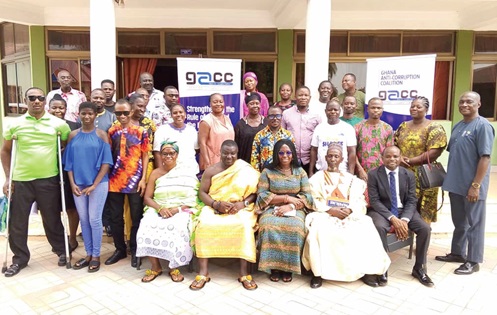
Boosting fight against corruption: 280 Stakeholders trained in 3 regions
Total of 280 stakeholders, including influential chiefs from the Bono, Bono East, and Ahafo regions, have completed intensive training in the Office of the Special Prosecutor (OSP) Act, 2017 (Act 959), positioning them to play a more decisive and informed role in the national fight against corruption.
Trained to strengthen their frontline role in reducing corruption, the beneficiaries were selected from nine districts in the three regions to deepen their knowledge and skills on how to engage the OSP and safely report corruption-related offences in their communities.
Districts
The districts are Sunyani West Municipality, Wenchi Municipality and Dormaa West District in the Bono Region; Techiman North District, Techiman Municipality and Kintampo South District in the Bono East Region and Tano North Municipality, Asunafo South District and Asutifi North District in the Ahafo Region.
Organised by the Ghana Anti-Corruption Coalition (GACC) and supported by the Participation, Accountability, and Integrity for a Resilient Democracy (PAIReD) programme, the training forms part of the GACC project “Strengthening the Rule of Law and the fight against corruption in Ghana".
It is being commissioned by the German Federal Ministry for Economic Cooperation and Development (BMZ), co-financed by the European Union (EU) and the Swiss State Secretariat for Economic Affairs (SECO).
The project is implemented by GIZ in partnership with the Ministry of Finance to educate citizens about the OSP Law and encourage them to uphold integrity and accountability in governance.
Commitment
At Fiapre near Sunyani in the Sunyani West Municipality, the Executive Secretary of GACC, Beauty Emefa Narteh, told the Daily Graphic that AGCC was committed to enhancing citizens' appreciation or knowledge, especially the legal framework for fighting corruption.
She said GACC had observed that since the establishment of the OSP, they had not been able to enhance citizens' understanding and appreciation of the office.
Mrs Narteh said since the establishment of the OSP, it had played a key role in investigating and prosecuting corruption and corruption-related offences.
She, however, said the public knowledge and understanding of the OSP’s mandate, powers, and operations remained limited, especially at the local level.
Mrs Narteh explained that the training, which forms part of the nationwide campaign, was designed to address those gaps to facilitate the fight against corruption.
Topics
The participants were taken through different forms of corruption, such as bribery, nepotism, embezzlement, favouritism, extortion, fraud, abuse of power, conflict of interest, and payment of facilitation fees.
It's an initiative aimed at promoting public understanding and collaboration about the mandate of the OSP.
The implementation carried out in two phases covered 60 districts across the country.
The initiative featured multi-stakeholder forums and media engagements designed to deepen citizens’ knowledge of the OSP Law and other corruption-related issues while encouraging active participation in Ghana’s anti-corruption efforts.
The forums brought together institutions and organisations such as the National Commission for Civic Education (NCCE), the Commission on Human Rights and Administrative Justice (CHRAJ), local authorities, civil society, and traditional and religious leaders.
Other groups are youth groups, persons with disabilities (PWDs), media practitioners, and community-based organisations to discuss the OSP’s mandate and its role in promoting transparency and accountability.
Apart from the forums, there were a series of media engagements in communities and local radio stations, discussions across the implementing districts to foster strong collaboration between the OSP, civil society, and the public in the fight against corruption.
Roles of citizens
Mrs Narteh said the training was to expose the role and mandate of the OSP as well as citizens' roles, responsibilities and the channels to report corrupt practices to the office.
She said OSP alone could not fight corruption without citizens' support and urged the public to support the office to reduce corruption.
Mrs Narteh added that the training was to facilitate the work of the OSP, such as arrest, investigating and prosecuting corrupt offenders in order to deter others from engaging in the negative practices.
She said the country was not doing well in the fight against corruption.
"We cannot just be complaining about corruption without doing nothing,” she said.
Mrs Narteh said the country was losing huge amounts of money through corruption and underscored the need for citizens to act to reduce the menace.
Biggest canker
At Wenchi, the Assistant Programme Officer of GACC, Dorcas Afum Tenkorang, described corruption as the "biggest canker" destroying Ghana’s democracy.
She said the fight against corruption should not be left to a single institution and called for all citizens to participate in the fight against corruption.
Ms Tenkorang urged the public to leverage the existing anti-corruption institutions such as Economic and Organised Crime (EOCO), CHRAJ, Whistleblower Act, the Witness Protection Act and the OSP to help fight corruption.
“This project is to enhance the effectiveness of key government institutions and agencies to help in the fight against corruption, while encouraging civil society organisations, women, youth and the media to actively participate in the fight against corruption", she said.
Participants
Some of the participants who spoke to the Daily Graphic expressed gratitude to GACC and its partners for organising the training.
They said the engagement had helped to enlighten their knowledge of OSP laws and had built their capacity to identify and report suspected corrupt practices to the appropriate authorities without fear or intimidation.
They called for regular engagements, expressing the hope that frequent forums such as the GACC sensitisation would help reduce corruption in the country.
Writer's email:
