
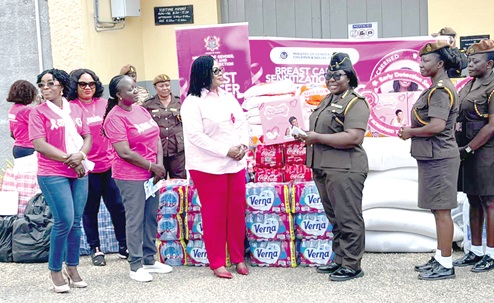
Gender Minister calls for inclusive health care for prison inmates
The Minister for Gender, Children and Social Protection, Dr Agnes Naa Momo Lartey, has said the time has come for the country to prioritise inclusive and preventive health care as a national responsibility, ensuring that persons behind bars equally benefit from national health initiatives.
“The people behind bars are equal citizens as we are. It’s one situation or the other that has brought them here. When we talk about service to the nation, we don’t leave them out,” she said.
She made the remarks at the national launch, sensitisation and screening exercise for breast cancer awareness month, held at the Nsawam Female Prison on the theme: “Catch It Early, Treat It Right, Survive It.”
Inclusiveness
Speaking at the event last Thursday, Dr Lartey explained that the initiative formed part of activities marking Pink October, aimed at raising awareness, screening female inmates and officers for breast cancer, and providing the necessary follow-up support.
She said the ministry, under the direction of President John Dramani Mahama, was working to ensure that social protection and health initiatives reached every corner of the country, including correctional institutions.
“It is for us to touch base everywhere we can reach. We came here to screen, to support, and to let them know they are not forgotten, “she said.
She added that the exercise was not only about screening but also an opportunity to strengthen the partnership between the ministry and the Ghana Prisons Service in promoting the welfare of inmates and officers.
As part of the exercise, Dr Lartey and her delegation presented assorted items to support the welfare and rehabilitation of the inmates.
The donation included bags of rice, bags of washing powder, boxes of sanitary pads, medications, bags of sachet water, packs of bottled water, drinks, and tissue.
She said the gesture formed part of the ministry’s social welfare and outreach programme to extend care to vulnerable groups, including those in correctional institutions.
“We came here to show our love, appreciation and support to the inmates and officers. We also want to assist with their rehabilitation work in our own small way,” she said.
She commended the management and staff of the Nsawam Female Prison for maintaining high standards of cleanliness and discipline, noting that the facility’s environment was “very impressive and hygienic”.
Dr Lartey underscored the importance of early detection in the fight against breast cancer, pointing out that the cost of creating awareness was minimal compared to the expense of treatment.
“When you consider the cost of getting medical care for an affected person, you realise that awareness creation is cheap. It is better to invest in prevention than in cure, “she said.
She further explained that early screening could save many lives and encouraged Ghanaians to overcome the fear and stigma associated with breast cancer checks.
“We don’t have a cure yet, but we can save lives when it is detected early. It is not a death sentence,” she emphasised.
Dr Lartey disclosed that some early detections had already been made during the exercise and gave an assurance that the ministry would collaborate with the Ministry of Health and the Ghana Medical Trust Fund to ensure that affected inmates received the necessary care.
Rehabilitation
The Deputy Director of Prisons and Officer in Charge of the Nsawam Female Prison, Deputy Director of Prisons (DDP), Victoria Adzewodah, outlined several rehabilitation and empowerment programmes being implemented at the facility.
She said the Nsawam Female Prison, the largest women’s correctional facility in the country, was running various vocational training programmes to equip inmates with employable skills before their release.
“We are doing a lot to ensure that each inmate is given a skill, education or empowerment opportunity so that when they return to society, they can be self-sufficient,” she said.
She added that some inmates were also benefiting from educational programmes such as non-formal education, the University of Cape Coast Distance Education, and National Vocational Training Institute (NVTI) courses.
“At the moment, seven inmates have been registered to write the NVTI examination in December,” she said.
Appeal
DDP Adzewodah appealed to faith-based organisations, philanthropists and corporate entities to support the prison’s rehabilitation and empowerment projects.
She commended the Ministry of Gender, Children and Social Protection for including the facility in the national sensitisation exercise, describing it as a reflection of the government’s commitment to equity and inclusivity.
