
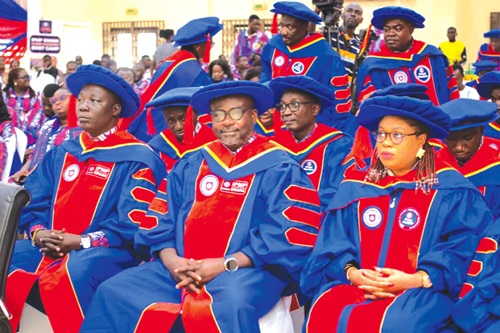
Institute of Project Management inducts 115 members
The Institute of Project Management Professionals (IPMP) Ghana has inducted 115 new members from various sectors across the country, at the climax of its 2025 Annual Conference held last Saturday in Accra.
The inductees included 10 Distinguished Fellows, 22 Fellows, 65 Project Management Consultants, four Master Project Management Professionals and 14 Chartered Members.
Notable among the attendees were Executive Director of IPMP, Prof. David Ackah, President of IPMP, Dr Mark Owusu Ansah, the acting CEO of Ghana Shippers Authority, Prof. Ransford Gyampo, Academic Lead for Logistics, Operations, and Supply Chain Management at the University of Strathmore Business School in Nairobi, Prof. Jonathan Annan and former Head of the University of Cape Coast School of Business, Prof. John Gartchie Gatsi.
Conference
The two-day conference on the theme, "Resetting Ghana: Leveraging Project Management for National Transformation and Sustainable Development," positioned project professionals as strategic drivers of Ghana’s development agenda.
It brought together thought leaders, policymakers, project professionals, and industry stakeholders to explore how modern project management strategies could accelerate economic recovery, drive sustainable development and deliver measurable results aligned with national priorities.
In addition to the induction ceremony, the first day featured a workshop aimed at equipping professionals with advanced skills, promoting knowledge sharing and encouraging the adoption of global best practices in project delivery.
Actionable change
In his keynote speech, the IPMP Executive Director emphasised that Ghana’s potential remains hindered by poor execution, policy inconsistency, and infrastructure gaps and argued that the nation could no longer afford to be rich in plans but poor in results.
Project management, Prof. Ackah asserted, must become central to national development—transforming visions into reality through effective governance, accountability, and timely delivery.
Citing global best practices such as Agile, PRINCE2, and Kanban, he called for the institutionalisation of project management across the public sector, to empower the youth, link funding to outcomes, and align national efforts with the UN Sustainable Development Goals.
"Imagine a Ghana where every road project has a defined timeline and is completed оп schedule. Imagine a Ghana where every hospital project has a clear sustainability plan. Imagine a Ghana where policies are implemented like project milestones, deliverables, and measurable impact," he said.
"If Ghana is to meet these targets, then project managers are not just implementers.
They are architects of sustainable development," he said.
Prof. Ackah urged policymakers to transition from political cycles to project cycles, and challenged the private sector to invest in impact-driven initiatives and position IPMP Ghana as a leading force for setting standards, shaping policy, and driving national progress.
Reform
Prof. John Gartchie Gatsi delivered a thought-provoking address emphasising the urgent need for reform in Ghana’s project management practices to drive national development and economic stability.
He noted a concerning lack of private sector involvement in project execution, despite similar development targets, and called for stronger engagement.
He highlighted the connection between poor project planning and rising national debt and stressed the need for better cost control, project design, and institutional reforms to prevent cost overruns and incomplete projects.
Prof. Gatsi concluded by affirming that “resetting” Ghana is not just a slogan, but a deliberate commitment to integrity, reform, and results.
"Of course, project management has a relation with the growth and development of our economy, and if we do things very well, we will enhance our growth and achieve long-term growth.
Project management actually has a role in all these things that I have discussed”.
Rule enforcement
Prof. Ransford Gyampo touched on the importance of rule enforcement, disciplined implementation, and industrialisation as the bedrock of national transformation.
He stressed that knowing and enforcing rules, planning with integrity, and delivering on policies are non-negotiable pillars of development.
Prof. Gyampo made a strong case for disciplined project execution, visionary leadership, and technically competent professionals, including certified planners and project managers.
"Now, industrialisation has long been the engine of economic transformation across the world.
And it has been a very long, very long time ago, except for a few years. I do have some scientific studies."
"No country has ever been a place without industrialisation.
Now, while in Ghana, industrialisation is not merely an economic opportunity. It is an existential opportunity," he said.
