
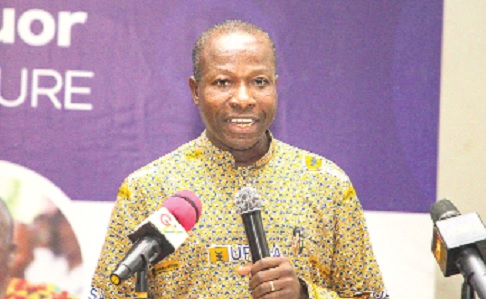
Maiden JAK Annual Disability Lecture: Train more journalists in disability reporting — Dr Bomfeh Jnr
A call has been made for the training of more journalists in disability reporting to help facilitate the effective implementation of the Disability Law in the country.
People With Disability (PWD) should also be encouraged to be trained and recruited into mainstream media practice to better appreciate the situation and give more coverage on practicalising the law.
A lecturer at the University of Professional Studies (UPSA) Accra, Dr James Kwabena Bomfeh Jnr. (Kabila), who made the call at the university last Tuesday, therefore, urged the National Media Commission (NMC) and the Ghana Journalists Association (GJA) to take up the challenge in building the capacity of media practitioners in that sector.
The maiden lecture was under the auspices of the John Agyekum Kufuor Foundation, with support from the Konrad Adenauer Stiftung of Germany, UPSA, and the Ghana Federation of Disability Organisation (GFD).
It was on the theme: "The stark reality of disability legislation in Ghana."
These were contained in Dr Bomfeh Jnr’s 11-point recommendations captured in his 45-minute presentation.
Others were for the Ghana Education Service to introduce curricula for basic schools on disability awareness, understanding disability and the ABC of disability.
He also called for strengthening of legal definition and scope with cultural undertones in the definition of disability to cover political rights, housing and digital inclusion, among others.
Dr Bomfeh Jnr posited that despite it's comprehensive scope, implementation of Act 715, passed into law in 2006, remained weak.
He said although the Act called for the development of a Legislative Instrument (LI) to operationalise it's provision, nearly two decades later, the instruments in the law were still pending.
Statistics
Dr Bomfeh Jnr said a 2025 accessibility audit revealed that only 14 per cent of public facilities had any retrofitting for accessibility; eight per cent had accessible toilets and zero per cent of transport systems met accessibility standards.
More worrying, he said, was the fact that municipal and district assemblies (MMDAs) lacked budgetary allocations and technical capacity to enforce the Act, despite a 2017 executive guidelines for MMDAs.
Dr Bomfeh Jnr said the 10-year moratorium for retrofitting public buildings expired in 2016, "yet enforcement remain doubtful".
"Let it remind us that disability inclusion is not a technical adjustment; it is a moral reckoning. It is not a niche concern; it is a national test.
"It is not a favour to the few; it is a measure of our collective humanity and a healing to our distorted selves," he added.
Awareness
Dr Bomfeh Jnr further expressed concern over the low awareness of Act 715 among the general public, including PWDs.
It has been established that many PWDs neither know their rights under the law nor how to assert them through legal or administrative channels.
To this end, Dr Bomfeh Jnr called for increased education on the Act and relevant provisions of the 1992 Constitution on disability in a format fit for all.
According to the World Health Organisation (WHO), about 40 per cent of Africa's population consisted of people with disabilities, including 10-15 per cent of school-age children, representing about 300 million people.
In Ghana, PWDs population stood at 737,743, constituting about three per cent of national population in 2010.
In 2021, the figure rose to 2,098,138, representing about eight per cent of national population.
