
NADMO unveils framework for national disaster management
The National Disaster Management Organisation (NADMO) has taken a major step towards strengthening its disaster management with the formulation of a national disaster management and risk financing strategy framework (DMRF) and implementation plan.
The framework, developed with technical support from the United Nations Development Programme (UNDP), is aimed at strengthening national resilience against natural and man-made hazards.
It also seeks to ensure timely access to finance for response and recovery while safeguarding national priorities and enhancing resilience across sectors.
The five-year (2025-2030) strategy framework is anchored on eight strategic priorities, including comprehensive risk identification, integration of disaster risk analysis in planning, budgeting, and establishing a portfolio of sovereign and sub-sovereign disaster risk financing instruments.
Implementation
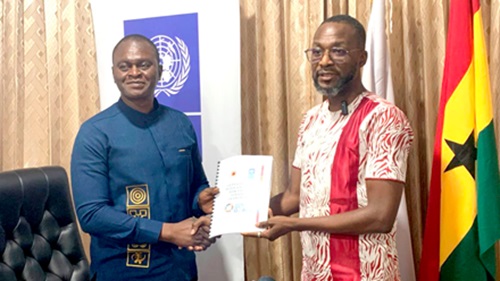
The Director-General (DG) of NADMO, Major (Rtd) Dr Joseph Bikanyi Kuyon, received the policy brief during a ceremony at the NADMO Head Office in Accra last Wednesday, from representatives of UNDP.
The implementation of the DMRF is expected to reduce the estimated $200 million the country loses annually to disasters, with floods, droughts, and fires affecting over two million people annually.
It would also advance the country’s effort in achieving SDG 11 (Sustainable Cities and Communities) and SDG 13 (Climate Action), contributing to inclusive, resilient and sustainable development.
Proactive disaster
At the event, Major (Rtd) Dr Kuyon stated that the strategy would help the country shift its response approach to disaster management from reactive disaster response to proactive risk management.
“I must say that the development of this strategy indicates Ghana's alignment with the global shifts in disaster management from disaster response to disaster risk management. It's obvious that the benefits that will come from this strategy implementation are enormous,” he said.
Dr Kuyon stressed that investing in disaster risk reduction was far cheaper than responding to and recovering from disasters.
“Over the years, we waited until the disaster comes before we fight it, but the world is beginning to realise that it is more important to invest in risk management than to wait until the disaster occurs before you fight it,” he stated.
The DG of NADMO expressed gratitude to the UNDP for its technical and financial support in the development of the framework.
Boost resilience
The Head of Environment and Climate at UNDP Ghana, Dr Abdul-Razak Saeed, said the DMRF would allow the government to better plan and allocate resources.
The strategy, according to him, would also enable the country to access innovative financing options and crowd in private sector investment.
“It allows us to be able to build the planning into our systems; it's also a document that allows us to look for the necessary financial resources and to be able to know where we have the resources and where we do not, and what approach we need to adopt to be able to do this,” he said.
Dr Saeed stressed the need for NADMO to communicate its achievement on disaster risk management, as a means to also attract investments.
“Putting this out there allows us to draw in investments into this.
We are at a stage in the world where donor funding alone is no longer working, and we need to be able to find innovative means to bring in finance,” he said.
