
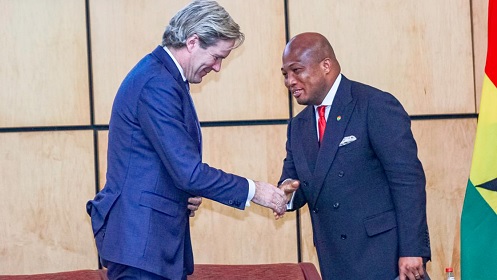
Okudzeto Ablakwa advocates multistakeholder approach to eradicate synthetic drug market
The Minister of Foreign Affairs, Samuel Okudzeto Ablakwa, has called for a comprehensive and multisectoral approach to address the growing threat of drug trafficking and synthetic drug markets in West Africa.
He underscored the devastating effects of synthetic substances like “kush” and pharmaceutical products like codeine on the country’s youth and communities.
Mr Ablakwa was speaking at the closing ceremony of a two-day Regional High-Level Dialogue on Drug Markets in West Africa Synthetics, Cocaine, Criminal Money and Strategic Responses in Accra last Friday, November 28, 2025, co-hosted by the Government of Ghana, the Kingdom of the Netherlands and the Global Initiative Against Transnational Organised Crime (GI-TOC).
It aimed at mapping the future of West Africa’s drug markets and strengthening coordinated strategies to address emerging threats. It brought together participants from the United Nations Office on Drugs and Crime (UNODC), ECOWAS, civil society organisations and law enforcement agencies.
Cooperation
The foreign minister stressed the need for regional cooperation, intelligence sharing and harmonised legal frameworks to disrupt transnational criminal networks exploiting West African borders and young populations.
As part of key priorities in dealing with the menace, he affirmed that strengthening intelligence sharing, building forensic capacity, disrupting financial foundations of drug trafficking, protecting youth through prevention programmes, promoting treatment and rehabilitation services were essential.
Mr Ablakwa said the country stood ready to collaborate with partners to build a safer, healthier and more secure West Africa, free from illicit drug markets; saying, the country was committed to working together with regional and international partners to implement evidence-based policies, reduce harm and protect communities.
“We recognise that success in curbing drug markets depends on enhanced intelligence sharing, coordinated enforcement operations and harmonised legal frameworks across member states,” he said.
Global threat
The Minister of Justice and Security of the Kingdom of the Netherlands, Foort van Oosten, called for global cooperation to combat drug trafficking, describing it as a global problem requiring global solutions.
Mr van Oosten underscored the Netherlands' role as a major hub in the international drug trade, with criminal networks exploiting its open economy and strong infrastructure.
He stressed the importance of shared responsibility and collaboration, citing the impact of drug-related crime on West Africa and Europe. Van Oosten praised the work of Global Initiative
Against Transnational Organised Crime (GI-TOC), a research initiative, and the Maritime Analysis and Cooperation Centre, for coordinating international efforts to combat drug trafficking.
The minister announced the Netherlands' commitment to supporting dialogue and cooperation with West African countries, strengthening information sharing and expanding networks to facilitate closer cooperation between agencies.
He stated that no country could overcome drug trafficking alone, and urged stakeholders to work together to address the threat.
Pragmatic response
For his part, the Minister for the Interior, Muntaka Mohammed Mubarak, stressed the need for a collective and pragmatic response to the rapidly evolving threat of drug trafficking and consumption in West Africa.
“The nature of drug trafficking and consumption in West Africa has changed dramatically and rapidly. Synthetic drugs are appearing where they once never existed, and traditional cocaine routes are mutilating with astonishing agility.
“Criminal networks are now liberating digital platforms, sophisticated financial channels, and transnational logistics systems that rival legitimate corporate supply chains,” he said.
Mubarak affirmed that the fight against drug trafficking required coordinated efforts, shared intelligence and harmonised legal frameworks to succeed.
He urged participants to translate commitments into measurable actions, shielding citizens, protecting borders and strengthening institutions.
He stated that these developments endangered not only public safety but also the credibility of the justice system in the West African subregion, the resilience of the youth, and the stability of the region’s democracy.
The minister for the Interior underscored the country’s commitment to addressing the threat of illicit drugs, as reflected in the Narcotic Control Commission Act, 2020 (Act 1019), which offered a blueprint in dealing with illicit drug trafficking.
