
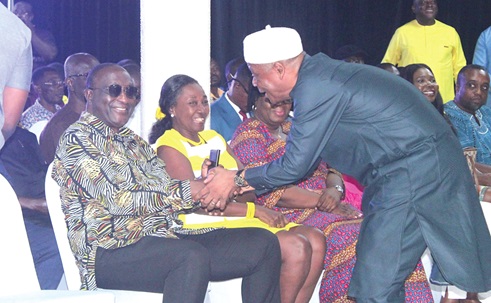
The Movement for Change has officially transitioned into a fully fledged political party, promising a new dawn in Ghanaian politics, with a vision to unite the country, transform the economy and end divisive partisan rule.
Named the United Party (UP), it draws inspiration from the original United Party formed in 1957 by the country’s then opposition forces following the passage of the Avoidance of Discrimination Act, which banned political parties based on ethnic, regional or religious lines.
The new United Party maintains the monarch butterfly logo of the Movement for Change, said to symbolise transformation, resilience and endurance.
It also maintains the yellow, black and white colours, representing the country’s gold wealth, the black star of Africa status, and purity respectively.
Membership
Its membership, particularly the frontline leadership, is dominated by former members of the opposition New Patriotic Party (NPP), which is itself a contemporary times replica of the previous UP.
The likes of former Director of Communication of the NPP, Yaw Boaben Asamoah; a former Minister and Member of Parliament on the ticket of the NPP, Boniface Abubakar Saddique; security operative under the NPP, Hopeson Adorye, along with other fellow former elite members of the NPP, including Solomon Owusu, Andrew Appiah Dankwa and Nana Yaw Sarpong, gave full expression to their defection from the party they once called home.
Instead, the new party now rallies the Ghanaian society for a new era of politics underpinned by an agenda to transform the country into an economic success, leveraging its vast natural resources, including human capital.
Credible alternative
Speaking at the launch in Accra yesterday, the leader of the founding group and a former member of the New Patriotic Party (NPP), Alan Kwadwo Kyerematen, said the new party would offer Ghanaians a credible alternative to the duopoly of the NPP and the National Democratic Congress (NDC), which, he said, had dominated the political landscape for decades without providing a clear vision for national development.
“Today, we are ushering in a new era, a new dawn that will end divisiveness, acrimony and rancour in Ghanaian politics,” he declared.
“The United Party will bring about economic transformation, create massive job opportunities, and usher in a golden age of business and prosperity,” he added.
Mr Kyerematen outlined the party’s vision, dubbed: “Vision 2040”, which aims to make the country the economic powerhouse of Africa by the year 2040.
He stressed that the UP’s mission was to build one united, peaceful, secure and prosperous country that provided equal opportunity for all Ghanaians, especially women, the youth and vulnerable groups.
Core values, ideology
Mr Kyerematen said the United Party would operate as a centrist political organisation, describing it as a “broad-based, middle-ground” movement that would bridge the ideological divide between the NDC and the NPP.
He emphasised that the party’s values were grounded on integrity, ethical leadership, discipline, law and order, meritocracy and excellence, while also promoting tolerance, patriotism, entrepreneurship and freedom of association.
“The United Party will promote decency in public discourse and instil discipline and patriotism among Ghanaians,” he said.
Highlighting key policy priorities from the party’s Great Transformational Plan (GTP), which was first unveiled under the Movement for Change in the lead-up to the 2024 elections, Mr Kyerematen said the UP would focus on stabilising the macroeconomy, reducing national debt and accelerating industrialisation.
He revealed that a UP government would prioritise the development of 10 strategic industries to make the country the manufacturing hub of Africa, drawing inspiration from China’s rapid industrial growth in the 1990s.
On agriculture, he announced plans to promote cash crop production and to privatise food marketing and distribution, with licensed companies operating in every district to ensure stable food supply and low prices.
Education, health, housing
In the education sector, Mr Kyerematen pledged to align the country’s curriculum with the industrial and development agenda by shifting focus from theoretical knowledge to practical and technical skills.
“We envision a future where young people will prefer trade schools to university degrees because that is where the employment will come from,” he said.
He also promised to introduce universal health coverage, with a focus on primary and preventive health care through a system that assigned doctors to neighbourhoods, and to integrate traditional and herbal medicine into the national health framework.
Housing, he said, would be a priority area, alongside efforts to advance pan-Africanism and promote the country’s leadership in continental economic integration.
A call for change
Mr Kyerematen took a swipe at the two main political parties, questioning their failure to articulate clear visions for the country.
He said the United Party would change the dynamics of governance and focus on results that directly improved the lives of ordinary citizens.
“We can bring decency and excellence back into our politics.
The United Party is the future of our country, a future of unity, peace, security and prosperity.
United we stand, divided we fall,” Mr Kyerematen said.
