
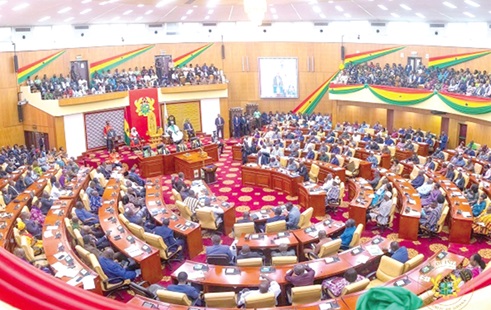
The Speaker of Parliament, Alban Sumana Kingsford Bagbin, has sparked a national conversation by proposing constitutional amendments to give traditional and religious leaders a role in Ghana’s parliamentary process.
Ghana’s democracy, he believes, is ‘backsliding’, due to escalating monetisation of politics and government ‘overreach’ creating critical vulnerabilities threatening the country’s democratic foundation. Democratic vulnerabilities include public service viewed as investment, where public positions are increasingly viewed as a financial investment rather than a form of public service.
Then there is systemic, seemingly escalating, public sector corruption, reflecting the immense financial pressure to recover exorbitant election campaign costs, which incentivises public officials to embezzle state resources.
A further concern is erosion of public trust: many believe that political figures can be ‘bought’ by special interest groups, severely weakening public confidence in the legislature, executive and judiciary.
Finally, an increasing risk of instability, which reflects seemingly uncontrolled political spending, which creates uneven playing fields, fuels pre- and post-election violence, and encourages citizens to be increasingly tolerant of unconstitutional regime changes, including military coups.
Remedy for democratic decline?
Speaker Bagbin’s remedy for democratic decline is to include religious and traditional leaders in Parliament.
Such people, he suggests, provide more ‘authentic’ leadership than politicians.
While many citizens turn voluntarily to these leaders for solace in times of trouble, politicians seek to impose themselves as leaders, which, he claims, highlights the need for national participation in constitutional review discussions.
To involve traditional and religious leaders in parliamentary issues could also help reduce excessive partisanship and foster greater national unity.
Democratic maturity
Political scientists refer to Ghana’s parliamentary democracy as ‘mature’ or ‘consolidated’, a position which has developed since 1993 following the commencement of the Fourth Republic.
Over the years, Parliament has passed numerous laws, agreed to national budgets, examined government expenditures, and exercised oversight of the Executive.
These achievements have contributed materially to the country’s democratic stability.
At the same time, Parliament has become increasingly polarised. Important national questions are almost always addressed along rigid party lines.
Inevitably, the numerical strength of the Majority or Minority – whether National Democratic Congress or New Patriotic Party – determines outcomes which might not represent a broad national consensus and serve to erode public confidence in the institution of Parliament.
Arguments for Inclusion
Including traditional (chiefs/queen mothers) and religious leaders in Ghana’s Parliament centres on leveraging their deep grassroots legitimacy, moral authority and capacity to unite citizens.
Proponents argue that integration will bridge the gap between statutory governance and indigenous values, ensuring that the national development trajectory aligns with cultural norms.
Many Ghanaians will agree that traditional authorities are custodians of Ghana’s customs, culture and communal values.
Religious leaders of various faiths exercise considerable moral influence over millions of citizens.
At various points in Ghana’s history, both groups have helped mediate conflicts, promoted social cohesion, and encouraged peaceful coexistence.
Potentially, their experience in consensus-building can enrich national discussions on matters of far-reaching consequence.
Advocates argue that giving them a formalised role in Parliament will tap into a deep reservoir of public trust, far exceeding the localised legitimacy of many partisan politicians.
In addition, integrating them into legislative processes can provide institutional avenues to de-escalate disputes and foster interfaith and inter-ethnic tolerance.
Finally, proponents contend that Parliament needs the moral and cultural grounding that traditional and religious figures provide, which can help protect Ghanaian societal values against perceived external cultural disruptions.
Arguments against inclusion
The case against parliamentary inclusion of traditional and religious leaders draws on three basic foundations of democracy.
First, there is the issue of democratic representation. Critics, including civil society organisations, argue that legislative power in a constitutional democracy must come from universal suffrage. Unelected religious or traditional leaders lack direct democratic accountability.
Second, to support the principle of separation of powers, the 1992 Constitution explicitly bars traditional leaders from participating in active partisan politics to preserve the neutrality of the chieftaincy institution.
A final concern focuses on institutional mechanisms.
Critics argue that existing advisory frameworks – such as the existing National House of Chiefs, the National Peace Council, and the Ministry of Local Government, Chieftaincy, and Religious Affairs, which oversees policies related to traditional authorities, preserves cultural values, and manages partnerships with the country's faith-based organisations – are the appropriate platforms for their input.
What now?
It is no coincidence that the discussion has surfaced during the broader constitutional review process.
Yet, the issue is complex and is sure to lead to a contested debate in relation to Ghana’s governance.
We should recall that democratic institutions are not static and that while safeguarding democratic values, constitutional systems should develop to reflect societal changes.
While Ghana should not reject Speaker Bagbin’s suggested reform simply because it departs from existing practice, the country should carefully consider whether the proposed reform will seriously undermine the principle that political power should derive exclusively from the will of the people.
The writer is Emeritus Professor of Politics, London Metropolitan University, UK.
