
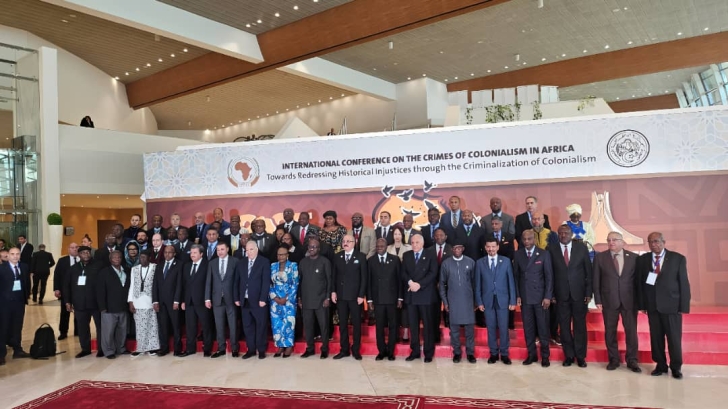
United front: Kwesi Pratt urges pan-Africanists to rally at conference in Algeria
A powerful call for African nations to unite in criminalizing colonialism resonated at the International Conference on the Crimes of Colonialism in Africa, held in Algiers from November 30 to December 1. Ghanaian pan-Africanist Kwesi Pratt Jr. took center stage, advocating forcefully for reparative justice.
On the sidelines of the conference, Mr. Pratt discussed the Special Accra Declaration on Reparatory Justice. This key document was originally adopted this November at an International Conference in Accra.
The diverse assembly of dignitaries in Algiers convened to examine colonialism's enduring impact and outline concrete steps for legal and political redress, centering on the movement to criminalize colonialism historically.
Mr. Pratt, a member of the Pan-African Progressive (PPF) Coordinating Committee, insisted that Africa must finally confront the full scale of colonial crimes. He argued that no continent has been more plundered, violated, and exploited. “Colonialism is the longest unpunished crime in human history, a crime whose victims were told to be grateful,” he told attendees.
He emphasized that the Accra Conference was not merely a gathering for remembrance, but a platform to indict a system that enriched Europe at Africa’s expense. “We have not met here today to merely recall a criminal history of bloodletting. We meet to indict an enterprise of murder, theft, and domination,” he declared.
The Special Accra Declaration outlines three major proposals: the establishment of a Joint Institute for Harm Assessment to document abuses and build a unified reparations framework; the creation of a Pan-African Reparatory Justice Fund to support education, health, infrastructure, and cultural programs; and an international solidarity contribution mechanism. This mechanism would call on states and corporations historically enriched by Africa’s exploitation to contribute up to one percent of the value of their operations on African soil.
Pratt reminded delegates that the damage of colonial rule remains visible across the continent. “Colonialism uprooted our peoples and sought to bury our memory under the rubble of its so-called civilization,” he stated.
He warned that the economic and political structures established during colonialism continue to operate today. “Africa is still being looted—not by gunboats, but by debt traps, corporate cartels, and digital extraction,” he said.
In conclusion, he urged Africa to unite behind this cause: “Colonialism was a crime. Colonialism remains a crime. And Africa must refuse silence.”
The primary objective of the Algiers Conference was to advance the criminalization of colonialism. Africa's history bears deep and indelible scars from colonization—including slavery, deportation, land dispossession, illegal exploitation of natural resources, denial of basic rights, and the deliberate destruction of cultural heritage.
Colonization destroyed traditional political and economic structures, fractured societies, and left an enduring legacy that continues to impede the continent's development. The fact that foreign powers conducted nuclear tests in several African countries underscores the extent of the damage, which has caused irreparable harm to people and nature, undermining the dignity, integrity, and security of entire communities.
The presentation in Algiers followed the International Conference Commemorating the 80th Anniversary of the Fifth Pan-African Congress in Manchester, which was held in Accra on November 18-19, 2025. That historic event brought together activists and politicians from over 50 African countries and the diaspora to strategize on advancing the global reparations agenda.
