
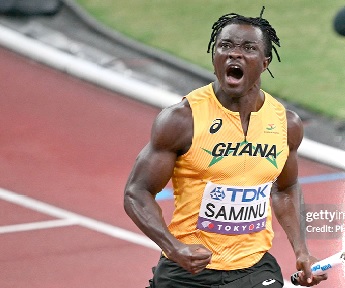
Saminu turns pro as ASICS deal fuels big ambitions
Ghana’s sprint king, Abdul-Rasheed Saminu, has officially shifted into top gear after sealing his first professional contract, signing a lucrative endorsement deal with Japanese sportswear giants ASICS.
The three-year agreement, running retrospectively from October 2025 to December 2028—with an option for 2029—marks a defining moment in the career of the man widely regarded as Ghana’s fastest ever and Africa’s third quickest over 100 metres.
Widely regarded as Ghana’s fastest man — and Africa’s third fastest ever over 100 metres — with a national men's 100m record of 9.84 seconds, the sprinter is now firmly positioned to chase bigger goals, with the 2027 World Championships and the Los Angeles 2028 Olympic Games clearly in his sights.
Crucially, the ASICS deal brings more than just branding. It provides vital elite-level structural support at a critical stage of his development, with ASICS set to cover travel costs, physical therapy and coaching allowances, resources that could prove decisive as Saminu transitions fully into the professional circuit and also prepares for a packed international calendar that includes the World Relays in Botswana and the Commonwealth Games in Glasgow.
An alumnus of both the University of Ghana and the University of South Florida, Saminu announced himself on the global stage in May 2025 when he shattered Ghana’s long-standing 100m record, clocking 9.86 seconds — a world-leading time at the time. Just two months later, he raised the bar again with a blistering 9.84 seconds.
Meteoric rise
Since then, his rise has been nothing short of electric. He reached the semi-finals at the Paris 2024 Olympic Games and played a key role in Ghana’s gold-medal-winning 4x100m relay team at the African Athletics Championships in Cameroon.
That upward trajectory continued at the 2025 World Championships in Tokyo, where Saminu again advanced to the 100m semi-finals and helped Ghana’s men’s 4x100m relay team break the national record on their way to a fourth-place finish in the final—further evidence of the country’s growing presence on the global sprinting stage.
With confidence soaring, Saminu has now set his sights on the African 100m record of 9.77 seconds, held by Kenya’s David Omanyala.
“That number is in my mind every day,” he admitted.
He also sees himself as part of a broader generational surge in African sprinting, pointing to the success of South Africa’s Akani Simbine and Botswana’s Olympic 200m champion Letsile Tebogo as proof of what is possible.
“We’ve got the talent,” Saminu said. “But we need better support—coaching, nutrition, facilities. Kids shouldn’t have to quit because they’re poor.”
Saminu’s immediate focus, however, is on rebuilding momentum after a mixed end to his NCAA career, where he failed to reach the 100m final and finished eighth in the 200m—well below last season’s podium form.
His next big goals will be qualification for the 2027 World Championships in Beijing, followed by a bold tilt at history at the Los Angeles 2028 Olympics, where no African has ever won men’s 100m gold.
“That has to change,” Saminu said quietly when reminded of the statistic.
