


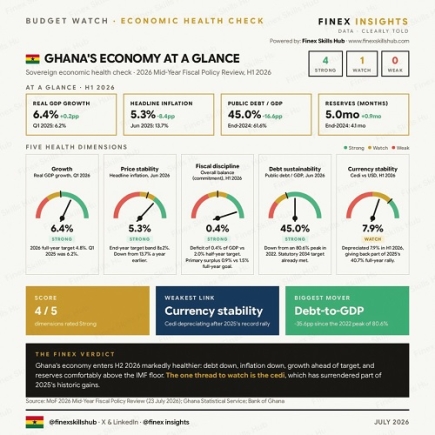
Ghana enters the second half of 2026 with strong economic momentum—marked by higher growth, plunging inflation, falling public debt and healthy reserves—though sustaining this recovery depends heavily on maintaining exchange rate stability.
Yet, amid the improving outlook, policymakers and economists say one risk continues to cast a shadow over the recovery: the stability of the cedi.
The government's 2026 Mid-Year Fiscal Policy Review, presented to Parliament on Thursday, July 23, paints the picture of an economy emerging from years of crisis management into a more sustainable phase of reform on the theme, "Resetting for Growth, Jobs and Economic Transformation."
One warning signal
Despite the broad-based improvement, economists caution that exchange rate stability remains the economy's biggest vulnerability.
The cedi depreciated by 7.9 per cent against the US dollar during the first half of 2026, reversing part of the significant appreciation recorded in 2025.
Although the depreciation is modest compared with previous episodes of currency instability, sustained weakness could reignite inflation, increase import costs and dampen investor confidence.
What analysts say
The Founder and Lead Trainer of Finex Skills Hub, Bernard Obeng Boateng, said Ghana's macroeconomic indicators now present a far more encouraging picture than in recent years.
"Economic growth is exceeding expectations, inflation has fallen sharply, public debt is on a declining path and international reserves remain healthy.
The principal risk to monitor is exchange rate stability, which will play a critical role in sustaining the broader economic recovery," he said.
Ghana's books look better than they have in years: debt down, inflation down, growth up. Services inflation is still at 9.4 per cent, kept high by transport fares, which is the part of the economy ordinary Ghanaians actually touch.
“The government has bought itself fiscal space; the real work now is converting that space into services people can see and feel," he added.
The Head of the Economics Department at the University of Ghana, Professor Edward Nketiah-Amponsah, also welcomed the improving macroeconomic outlook but warned that exchange rate pressures, geopolitical tensions in West Asia and the worsening security situation in the Sahel remain significant external risks capable of derailing the recovery.
The review argues that the painful fiscal adjustments and debt restructuring undertaken over the past two years are beginning to yield tangible results, with key macroeconomic indicators pointing to a more stable and resilient economy.
First sign of recovery
Real Gross Domestic Product (GDP) expanded by 6.4 per cent in the first quarter of 2026, comfortably exceeding the government's full-year growth target of 4.8 per cent.
The expansion reflects improved production, recovering business confidence and stronger domestic demand as macroeconomic conditions continue to stabilise.
The Finance Minister, Dr Cassiel Ato Forson, said the recovery was being driven by three broad reforms—fiscal correction, tax modernisation and fiscal policies to support inflation targeting and exchange rate stability.
As part of measures to stimulate domestic production, the government will abolish the 20 per cent excise duty on locally manufactured fruit juices, introduced in 2023, under the proposed Excise Duty Bill.
Dr Forson said the decision was intended to strengthen agro-processing, encourage local manufacturing and support job creation.
The move is expected to provide relief for local beverage manufacturers, fruit farmers and agribusinesses, many of whom had argued that the tax undermined the competitiveness of Ghanaian-made fruit juices at a time when the government is promoting industrialisation and import substitution.
Inflation falls sharply
The second positive signal is the dramatic decline in inflation.
Headline inflation slowed to 5.3 per cent in June 2026, down from 13.7 per cent a year earlier, marking one of the fastest disinflation episodes in recent years.
Lower inflation has eased pressure on household incomes, reduced uncertainty for businesses and created greater room for monetary policy to support private sector activity.
Debt burden eases
The third encouraging development is the continued improvement in Ghana's public finances.
Public debt has declined to 45 per cent of GDP, compared with 61.6 per cent at the end of 2024 and significantly below the 80.6 per cent peak recorded in 2022.
The government also posted an overall fiscal surplus equivalent to 0.4 per cent of GDP, while maintaining a primary surplus, signalling continued commitment to fiscal discipline and improving debt sustainability.
External buffers strengthen
The fourth sign of strength is the improvement in the country's external position.
Gross international reserves have risen to the equivalent of five months of import cover, comfortably above the International Monetary Fund's conventional adequacy benchmark of about three months.
The stronger reserve position enhances Ghana's capacity to meet external obligations, supports market confidence and provides an important buffer against external shocks.
He added that if fiscal discipline and prudent monetary policy are maintained, Ghana is well positioned to consolidate the gains made so far and strengthen investor confidence over the medium-term.
For now, however, the government's mid-year assessment suggests the economy has moved decisively away from crisis stabilisation towards recovery.
The challenge in the months ahead will be to preserve the hard-won gains by maintaining fiscal discipline, protecting exchange rate stability and sustaining the reforms needed.