
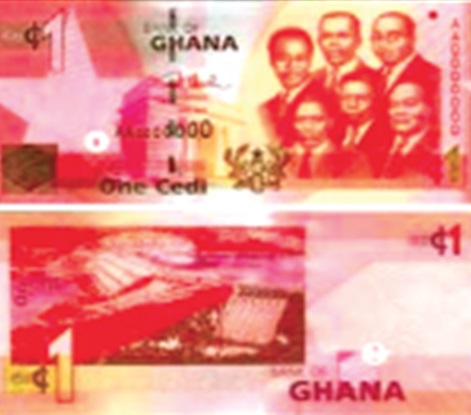
Ghana currently maintains an unusual monetary policy by allowing the one cedi (GH¢1) denomination to exist simultaneously as both a paper banknote and a metallic coin.
While this duplication may seem trivial to the public, it introduces significant inefficiencies in public finance, monetary operations, and overall economic discipline.
The Bank of Ghana has already demonstrated that a single-coin system works.
When the GH¢2 coin was introduced, it circulated alongside the GH¢2 note for a brief period.
Eventually, economic forces naturally phased out the paper note, leaving the coin as the dominant medium. Today, the GH¢2 note has virtually vanished from daily commerce.
Instead of applying this proven logic to the lowest denomination, Ghana has reversed course.
After the GH¢1 note had almost disappeared from circulation, it was reintroduced in large quantities.
This raises a critical question regarding why public funds are being used to manufacture two different physical forms of the exact same monetary value.
Financial, operational burden
From a public financial management standpoint, printing banknotes is a highly expensive venture.
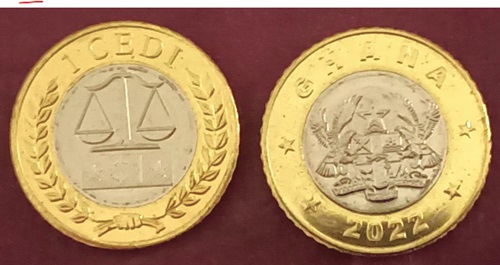
Front and back of the one Ghana Cedi coin
Low-denomination notes exchange hands rapidly, causing them to become dirty, torn, and unusable within a short timeframe.
Conversely, while coins require a higher initial manufacturing cost, they are exceptionally durable and can remain in circulation for 20 to 30 years.
Every time the government prints replacement GH¢1 notes, taxpayers absorb the recurring costs of specialised paper and security ink; transport, storage, and insurance; as well as processing and destroying unfit notes
Beyond direct production costs, the dual-system creates operational friction across the wider economy.
Businesses and banks waste time and labour counting, sorting and processing two different mediums for the same value.
Cash centres require extra storage space, and automated machinery—such as vending systems, parking meters, and transit payment points—becomes more complicated and expensive to calibrate.
Lessons
Global monetary history proves that phasing out low-value paper notes yields substantial savings.
• The United Kingdom: Completely replaced its £1 note with a £1 coin, finding the coin to be far more durable and economical over its lifespan.
• The Eurozone, Canada, and Australia: Progressively shifted all lower-value denominations from paper to coins to protect taxpayers from recurring printing expenses.
• The United States: Continues to maintain both the $1 note and $1 coin.
However, multiple Government Accountability Office (GAO) studies indicate that the dominance of the paper bill has severely limited the billions of dollars in long-term savings that a coin-only system would provide.
Strategic framework for transition
Ghana is currently pursuing strict fiscal consolidation, debt sustainability, and expenditure rationalisation.
Ministries and public institutions are under immense pressure to cut waste and do more with fewer resources; currency management should be held to the same standard.
To resolve this issue, the Bank of Ghana should implement a clear, structured solution:
• Cost-benefit assessment: Conduct and publish a comprehensive analysis of the GH¢1 denomination to verify its long-term taxpayer value.
• Phased withdrawal: Avoid an overnight ban.
Allow existing GH¢1 notes to naturally wear out and exit circulation, replacing them exclusively with coins.
• Public education: Launch a transparent communication campaign to explain the economic rationale, boosting public acceptance and preventing misconceptions.
Ultimately, sound economic management relies on eliminating redundant systems.
Eliminating the GH¢1 note would send a powerful message that Ghana's fiscal prudence begins with its smallest monetary unit.
The writer is a Chartered Accountant,
Internal Audit Manager,
Ubuntu Capital Microfinance Ltd.
E-mail:
